“The deliberate killing of a large number of people from a particular nation or ethnic group with the aim of destroying that nation or group…’a campaign of genocide.'”
Similar: Racial killing, massacre, wholesale slaughter, mass slaughter
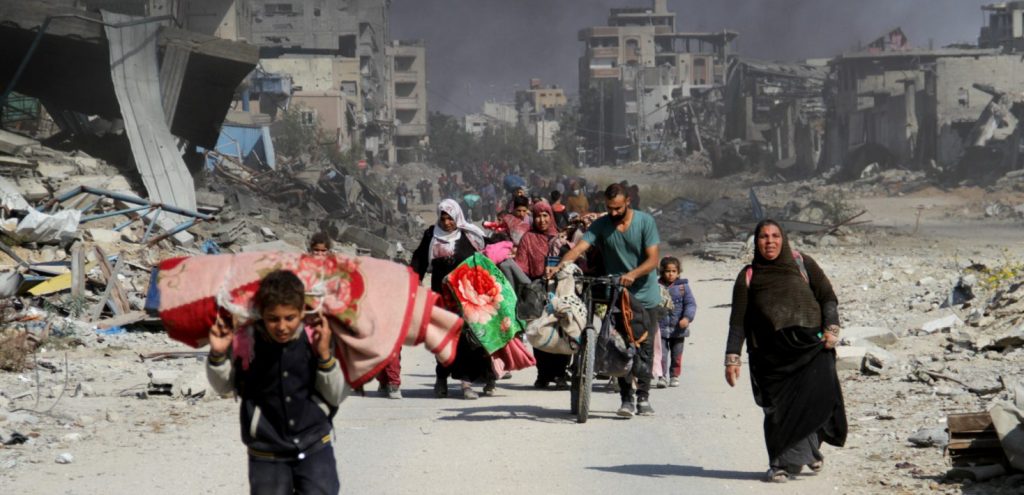
As of 10 December 2024, according to Wikipedia, over 46,000 Palestinians have been killed in Gaza. 70% of these deaths have been women and children. This number has been confirmed by Reuters, the BBC, CNN, and the AP, amongst others.
A recent investigation by Amnesty International has concluded Israel is committing genocide against Palestinians in Gaza.
I ask the reader, how will these actions bring lasting peace to the Region? How will these actions reduce hate and animosity between people? How will these killings ensure a safe future for the State of Israel?
And finally I ask, have we, the Jewish people, forgotten the meaning of Genocide? Is the cry “Never Again,” a proprietary ideal, or one that applies to all of humanity?
Does every question have an answer? “What is the boiling point of water?” Of course, the accepted answer is 212F/100C.
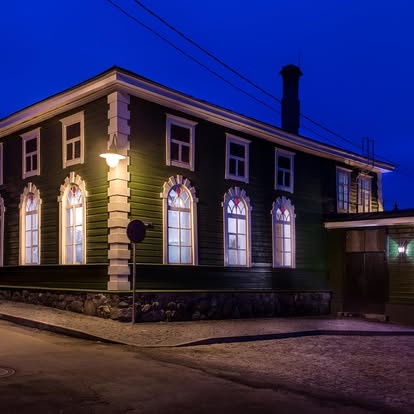
The Green Synagogue in Rezekne, Latvia
Why am I drawn almost magnetically to old synagogues in nearly every city I visit?
Since our recent journey to the Green Synagogue in remote Rezekne, Latvia, I have been pondering this question.
Well, as a Jew, feeling a need to visit synagogues would be a reasonable explanation. I am familiar with almost all the artifacts and rituals associated with a synagogue. Very little about them is “foreign” to me. Seeing a matzo oven on the ground floor of the Green Synagogue, while a pleasant surprise, is a familiar tradition. And yet, as I walked the Camino de Santiago the well-known pilgrimage across northern Spain, even being Jewish, I was often drawn to churches we passed along the way.
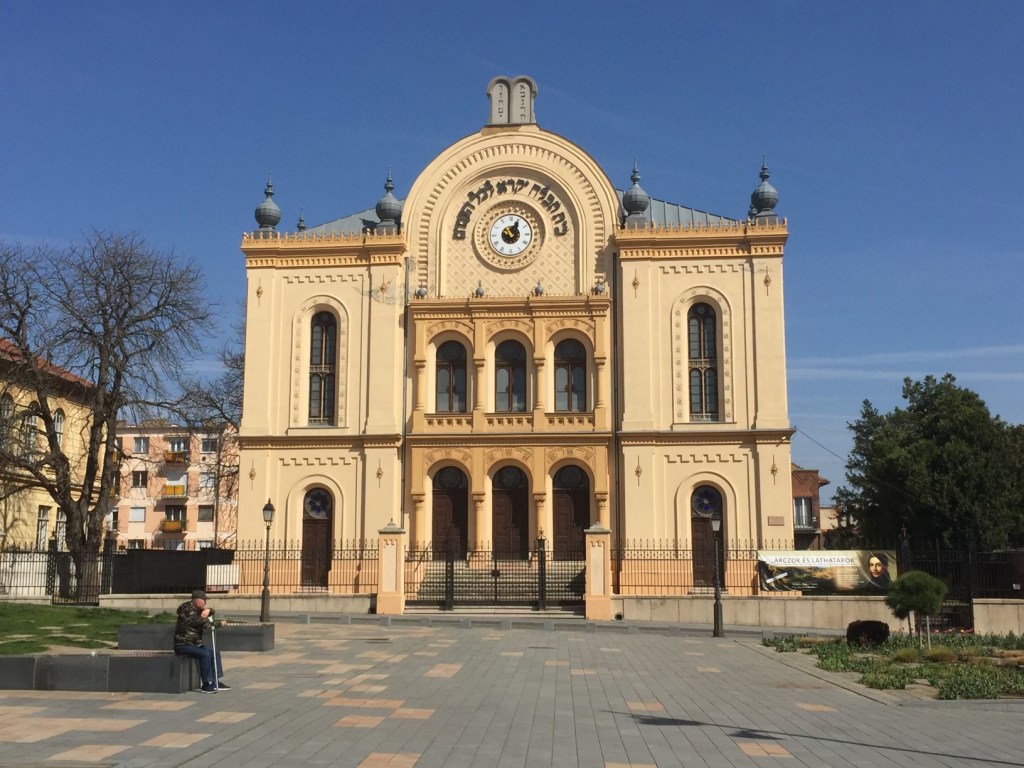
The Synagogue of Pecs, Hungary, consecrated in 1869.
Perhaps being a history buff makes as much sense as any explanation. I majored in history in college and remain fascinated with the connections old buildings, like synagogues, have with the country, cities, and cultures I find them in. The old synagogue in Pecs, Hungary, is part of that country’s dark history of suffocating the Hungarian Jews out of existence in a relatively short time during World War II. But it’s much more complex than solely the historical connections.
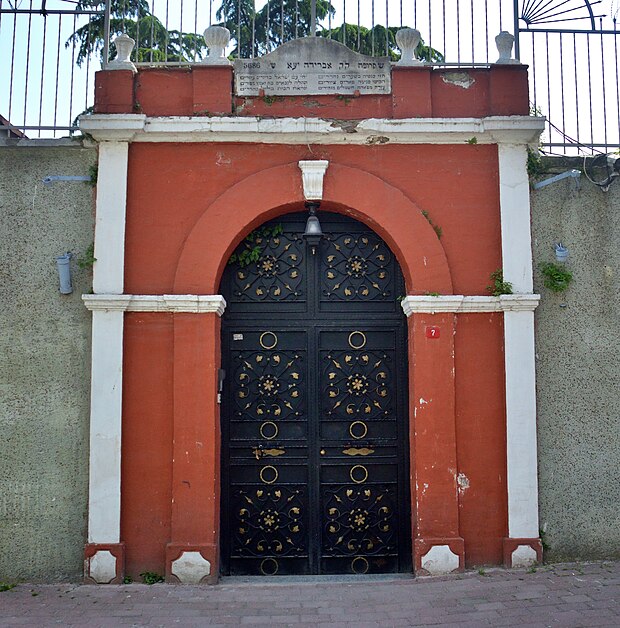
No, being a curious traveler is a much more reasonable explanation. Some of these old buildings have become world famous tourist destinations. The Ahrida Synagogue in the Fatih neighborhood in Istanbul, for example, was a stop on our tour in that Turkish city. It was built in 1430 as part of a then thriving Jewish community. My curiosity as a traveler was stopped in its tracks as I stood humbly in front of its ancient gate.
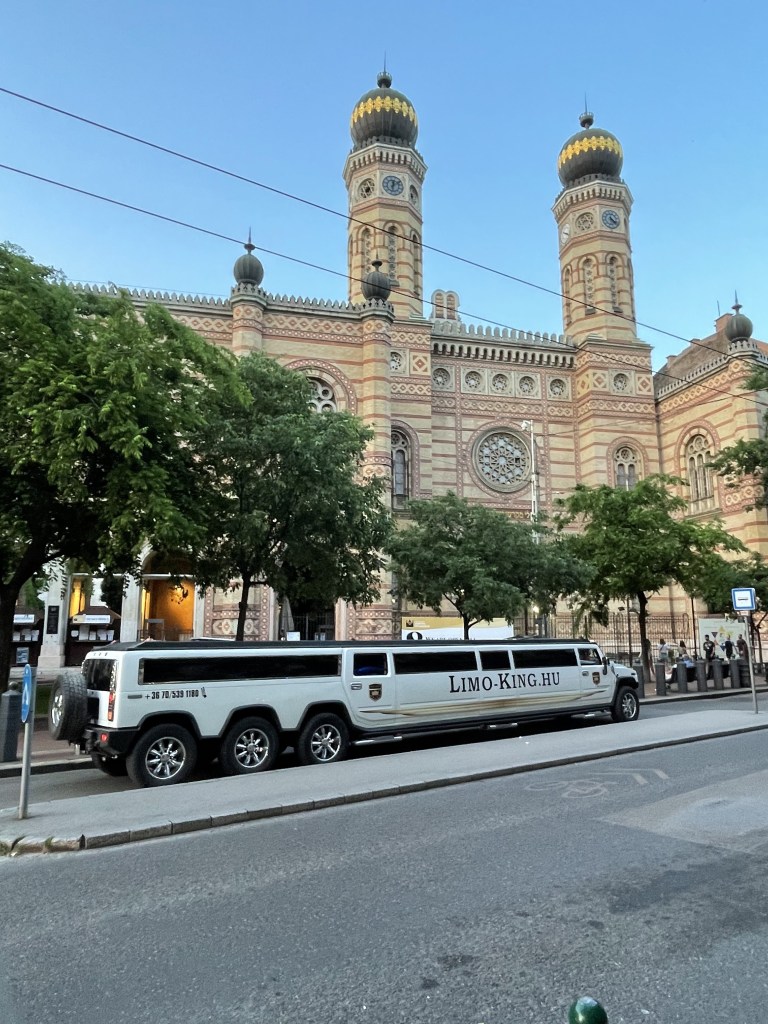
The Ahrida Synagogue (circa 1430) in the Fatih neighborhood of Istanbul.The Dohany Synagogue (1854) in Budapest is, understandably, on nearly every tourist’s itinerary
A traveler to Budapest can’t escape the overwhelming presence of the Dohany Synagogue in that amazing city so richly endowed with countless tourist destinations. It’s the world’s second-largest synagogue with an impressive seating capacity exceeding 3,000 people. Few travelers to Budapest miss stopping there.
I am drawn to synagogues for all these reasons and likely many more. But what I do know, is that I rarely connect to a place more intimately than I do through its synagogue. I feel part of their history–an intimate connection that often leaves me saddened when I depart.
Sad for what these old synagogues represent: once-vibrant communities that bloomed across most of Europe, now evaporated. Jewish people energized Budapest to the tune of 24% of its pre-World War II population. Vilnius, the capital of Lithuania, then nicknamed the “Jerusalem of the East,” once had 106 synagogues. Today, it has one. Cities and towns here in eastern Latvia had populations that were 50-60% Jewish. In the Rezekne of 1935, home of the Green Synagogue pictured above, 75% of all commercial businesses were owned by Jews.
So, why am I drawn to synagogues? Questions rarely have one simple answer. What is the boiling point of water? As we know, the boiling point of water is 100˚C and 212˚F, but alas, that’s only at sea level. Even for that one, there’s more than one answer…at different altitudes or pressures, the number is different. Answers to questions are always much more complicated than that.
“I am not so different in my history of abandonment from anyone else after all. We have all been split away from the earth, each other, ourselves.”
Susan Griffin
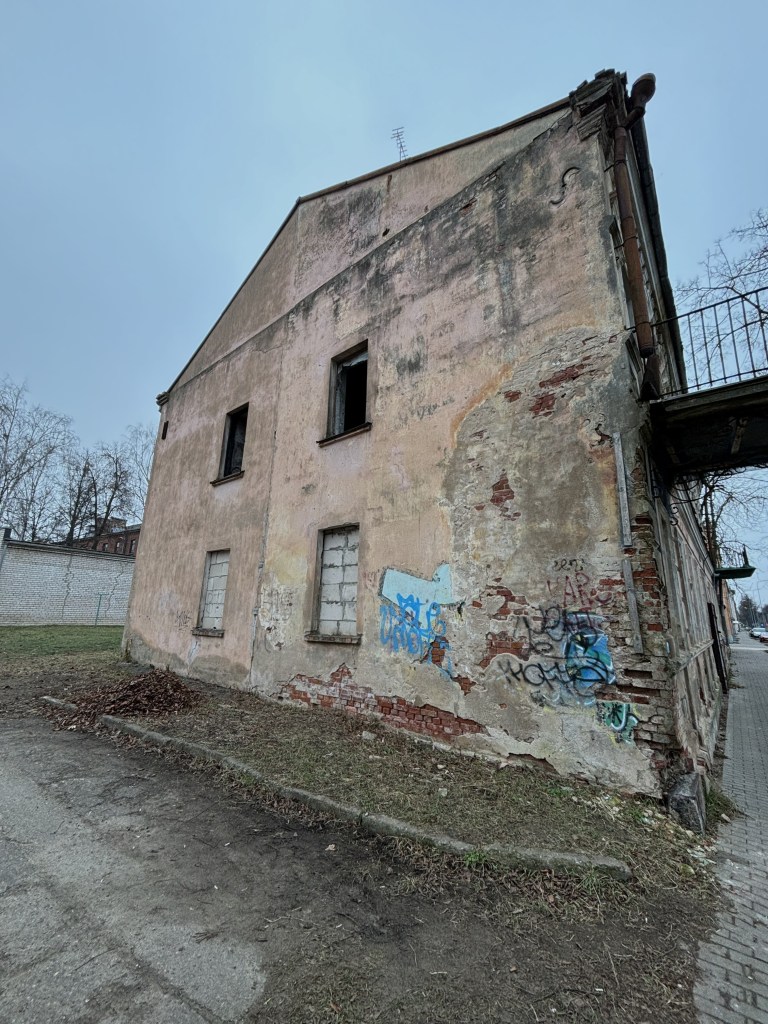
A once proud Polish military hospital stands empty on the grounds of an old fortress here in Daugavpils
Abandonment. It’s an unmistakeable and striking feature here in Daugavpils, Latvia. The city is dotted with a large number of unoccupied or abandoned buildings. In other places I know, Portland, Maine, or Budapest, Hungary, for example, these properties would occupy the dreams of developers. Not so here, with a continuously shrinking population and lower average incomes than in other parts of Latvia.
This building stands on November 18th Street-an address honoring Latvia’s Independence Day
Since the Russians departed in the early 1990’s, the factories have withered, and the belts, tightened. But hopefully, the once more vibrant and prosperous past here, is, as Shakespeare said in his play, The Tempest, prologue.
Even in their emptiness, even in their solitude, there is a kind of steadfast beauty and quiet promise of hope.
Flowers, perhaps a sign of hope, adorn this window ledge in an otherwise abandoned neighborhood
Donald Trump and those on the political Right have rode into town on their high horses brandishing their right, so they say, to change America’s school curricula. Oklahoma’s State Superintendent, Ryan Walters, has claimed that President Joe Biden, teachers unions and “their enablers” have pushed the Bible out of schools. “I’m proud to bring it back,” Walters has said, according to the Oklahoma Voice.
In Florida, Politico reported, Governor DeSantis has “rolled back higher education diversity programs, engaged in a high-profile feud with the College Board over its African American studies course and worked with other Republicans to reshape higher education in Florida by installing key allies in statewide posts.” “Because it’s a war on truth, I think we have no choice but to wage a war on woke,” DeSantis said.
In Texas, according to Spectrum News 1, the State Board of Education was recently told by that State’s Attorney General Office, that “U.S. Supreme Court precedent allows for the bible and religion to be taught in public schools in a non-proselytizing way.”
The Right is rallying around a bigoted and arrogant self-professed guru on all things educational, Dennis Prager. In one video, he role-plays the voice of his ideal public school principal saying to the students on the first day of school, “If you want to claim an ethnic identity as a student here, other than American, go attend some other school.”
Collectively, the Right wants to whitewash American history by deleting or banning all Black History classes because, as they widely tout, they make students feel “guilty” about being American. The problem is, if you spend any amount of time carefully listening to most of these advocates, their ignorance of both American history and educational practice, is shockingly obvious, and their racism, almost always, painfully apparent.
A recent poll asked the question, Should American schools should teach Arabic Numerals as part of their curriculum? The survey completed by 2,313 people revealed the following results:
Yes…………….29%
No………………57%
No opinion…..14%
To many, the term “Arabic Numerals” sounds foreign and threatening. I suppose then it would make sense that the term would stoke fear in the American Heartland. School Boards throughout the country will no doubt be adding a discussion of a response to this threat to agendas at their board meetings. “Arabic Numerals” are, of course, the numbers we all currently use in all our schools, the digits 0-9. The numbers are called “Arabic Numerals” because they came to Europe via the Arabic, or some offer, alternatively, the Indian, world.
Debates are certainly in order. But that’s just it, how can we have a reasonable debate about how to teach our children well, when the Ryan Walters, Ron DeSantis’ and Dennis Pragers of the world, hold advanced degrees in fear, loathing and racism?
What’s rotten of course is not something that’s occurring in Denmark, but rather the stench coming from my home, the United States. It’s the smell emanating from the rogue band of outlaws about to ride roughshod across America’s political, social and moral landscape. It’s justifiably setting off all sorts of alarms, creating new cottage industries, including countless articles on how to survive the coming apocalypse with titles like 10-Transformative Tips to Prepare for a Trump Presidency and Coping Tips for a Second Term.
For me, travel is the best elixir for all that ails about American politics. A stocking cap, my backpack and a wrinkled map is just about all I need. And the map, that’s optional. Somewhere I once read that a good cleanse of the soul could be had by just getting on a random tram and taking it to the end of the line. I’ve done that with good results many a time.
Alternatively, I love hopping a ferry to just about anywhere. My thick-treaded shoes can make a visit to a city park a memorable adventure. Sure, walking the 500-mile Camino de Santiago is guaranteed to help you leave Trump and his acolytes so far in the rear view mirror as to make them as small as their actual moral stature. But just to be clear, you don’t have to leave your seat to do some traveling. A gaze out the window tracing the flight of your local swallow works just fine.
Watching seagulls from aboard the ferry crossing Delaware Bay
Oh, and about Denmark…”‘Farewell, farewell,’ said the swallow, with a heavy heart, as he left the warm countries, to fly back into Denmark. There he had a nest over the window of a house in which dwelt the writer of fairy tales. The swallow sang ‘Tweet, tweet,’ and from his song came the whole story.” You don’t need a boat or plane ticket to get to Denmark. Just get a hold of a book from the author of that quote, Hans Christian Andersen, himself an amazing traveloguer.
I’ve had a lifelong habit, some in my family would say, obsession, of checking where things are made. I have been laughed at for looking for dates of manufacture, or cranking my head upward to look for the year when a building was built. I am simply curious about such things.
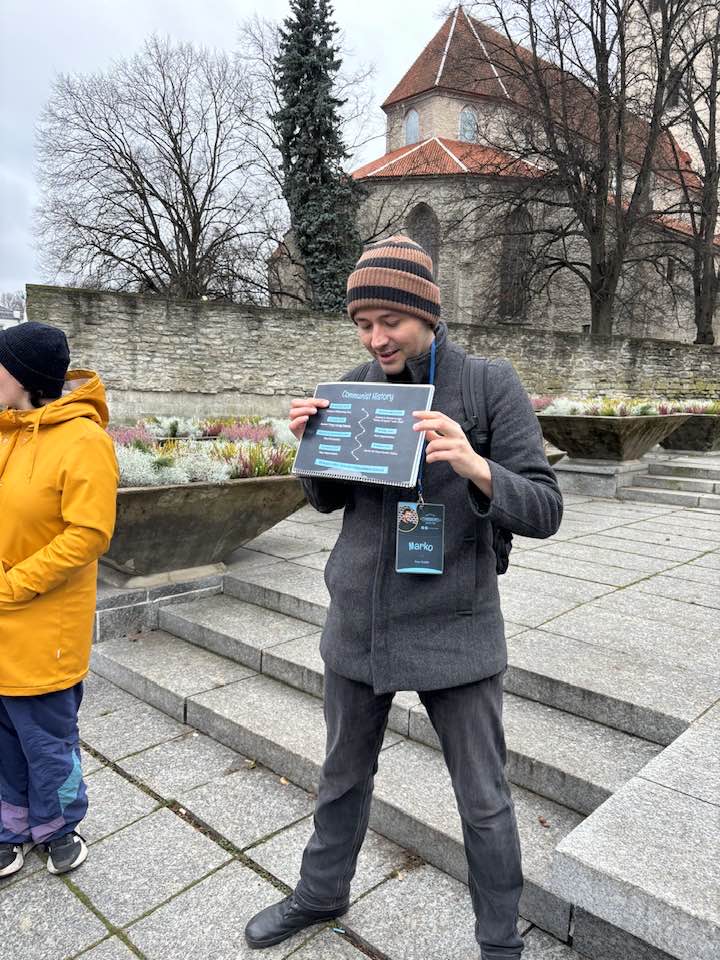
Just the other day here in Tallinn, Estonia, we scheduled ourselves for a local tour, as we often do when visiting a new city. For The Communist History of Tallinn, we were greeted by young Marko, an outgoing local, half-Jewish Estonian, half-Bulgarian, he was quick to tell us. We are already curious. As he begins the tour he displays a single blue card about the size of a sheet of paper covered in plastic. It contains a series of dates, flowing like a river, depicting key events that took place here during WWII. It became the focal point for 10-minutes of jaw-dropping history. Marko had ignited our curiosity.
Our tour guide, Marko, piquing our curiosity.
Back in Latvia, I am working on a project with local English teachers. They’re interested in improving their teaching effectiveness in the areas of Critical-Thinking and Reading. Disconcertingly, reading amongst younger students, we discuss, is a waning skill. How can adults, parents and teachers, stimulate reading curiosity in their students?
A Youtube video reel flashes across my computer screen. It quickly describes 6-Japanese Productivity techniques, one of which is called Shoshin. Originating in the 13th Century, Shoshin is a Zen Buddhist concept based on the principle of approaching every activity with the same curiosity as a wide-eyed beginner-engaging with childlike wonderment.
Fear it appears, discourages curiosity. What one might find around the corner, or under that cover, might be too scary for comfort. And for those reluctant to step out of their Comfort Zones, curiosity, is best left for cats.
But I’ll continue to indulge my curiosity-checking labels to see where my clothes are made. Heck, I even check the occasional fire hydrant or manhole cover to see where they are manufactured. Perhaps not surprisingly, many these days come from foundries in India. I wonder, just how many cats have been killed by being too curious?
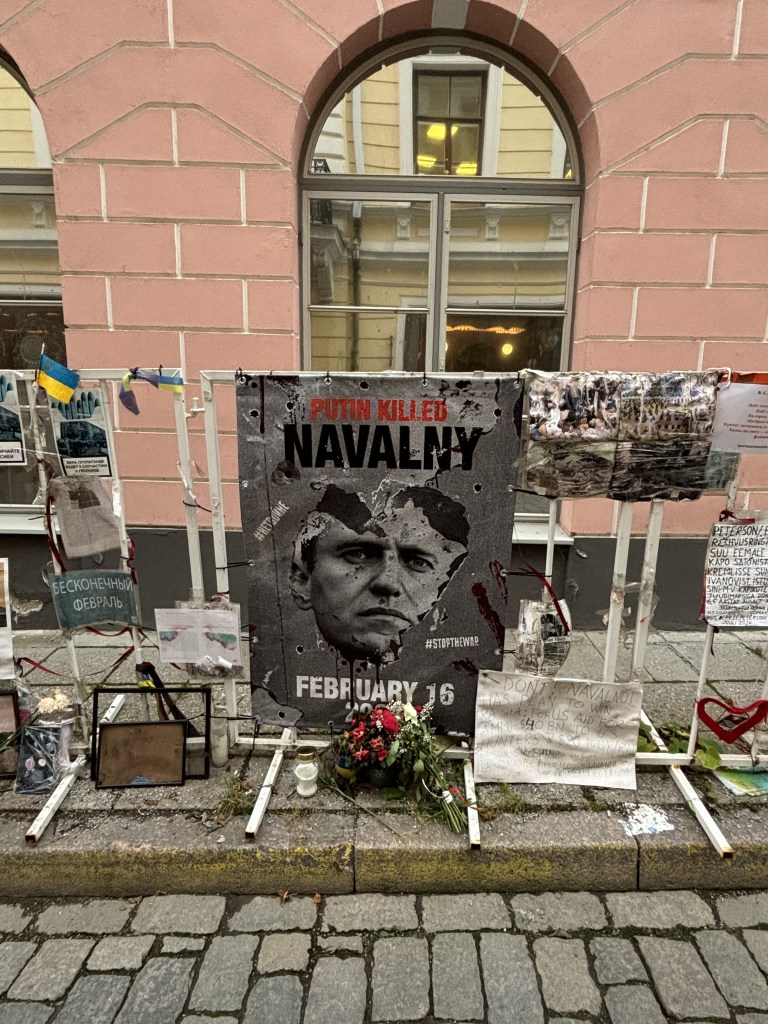
Poster of protest on the partition in front of the Russian Embassy in Tallinn, Estonia.
A few weeks ago we were traveling by bus from Latvia to Lithuania for an extended weekend visit to that country’s capital city, Vilnius. About 20-minutes before our arrival, I heard a voice, which I soon realized was directed toward me. It had an accent and came with a strong, cigar-like smell. “Excuse me, are you American?” “Yes,” I said, casually. “Well then, may I ask what are you doing here?” “I teach English in Latvia,” I answered. From there, the conversation started to quickly go down-hill. I was blamed for killing all the Native Peoples in North America. I was criticized for NATO, for America’s presence in Europe, and in quick succession, for every ill currently facing mankind. Russia, on the other hand, was on the right side of every issue. Putin was God. The North Korean soldiers, recently identified as having joined the fight against Ukraine, were innocent “trainees.” Soon, we arrived in Vilnius and my sudden adversary was thankfully catching another bus onward to his home in Dresden, Germany…
The next day, Marsha and I were answering her after-lunch desire for a piece of chocolate. We entered a handsome chocolate shop on popular Pilies Street in the touristy Old Town in Vilnius. The shopkeeper was giving us a tour, figuratively, through her fancy chocolates on display. I commented on her impressive English, and on her detailed knowledge of the then forthcoming US presidential election. Soon, a man in the shop, who had been sitting behind a curtain, came out and joined the conversation. He launched, in rapid succession, into rants about Biden, Obama, and Harris. We think, but are not sure, that he said “Jew Biden.” Zelensky is “a Nazi” who was installed by Obama, who really started the war in Ukraine in 2014. The death of 35+ journalists at the hands of Putin? All U.S. propaganda. The poisoning, jailing and subsequent death of Alexei Navalny in prison? All U.S. lies. America is the cause of all evil in the world and it is Trump and Putin who will save it. We try to exit the store civilly, with our purchase of sweets in hand…We needed time to process all this. These 2-separate events happening here in Lithuania within 24-hours of each other, are not typical of our stay here in the Baltics. We wonder, how many people in Eastern Europe feel similarly? We ask ourselves, how deep and strong do Putin and Russia’s bastion of misinformation run in the bloodstream here?
Wondering where we are headed in the U.S.? It’s here: Viktor Orban 2.0…He’s the Prime Minister of Hungary often quoted and idolized by Trump and his acolytes. He has installed himself, his family, and the thugs that surround him, as the forever illiberal leader of Hungary. He hates immigrants, homosexuals, the EU, and NATO. He has rewritten the Hungarian constitution to, among other things, severely limit the amount of time the opposition has to use TV and radio during campaigns. He closed a major university that he felt challenged his opinions and policies. He has taken over successful Hungarian businesses and awarded them to family members and friends. Trust me, I’ve lived and worked in Hungary. With Trump’s November “Viktory,” welcome to what’s coming our way.
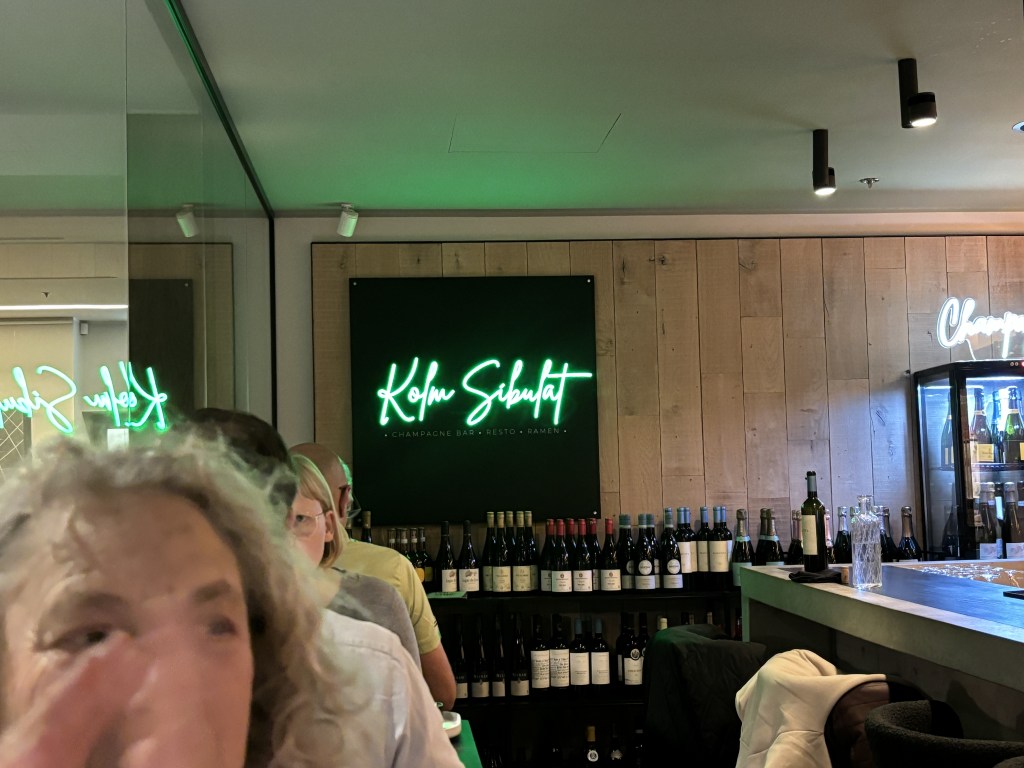
Kolm Sibulat, or 3-Onions, is a pleasant walk from Tallinn’s Old Town
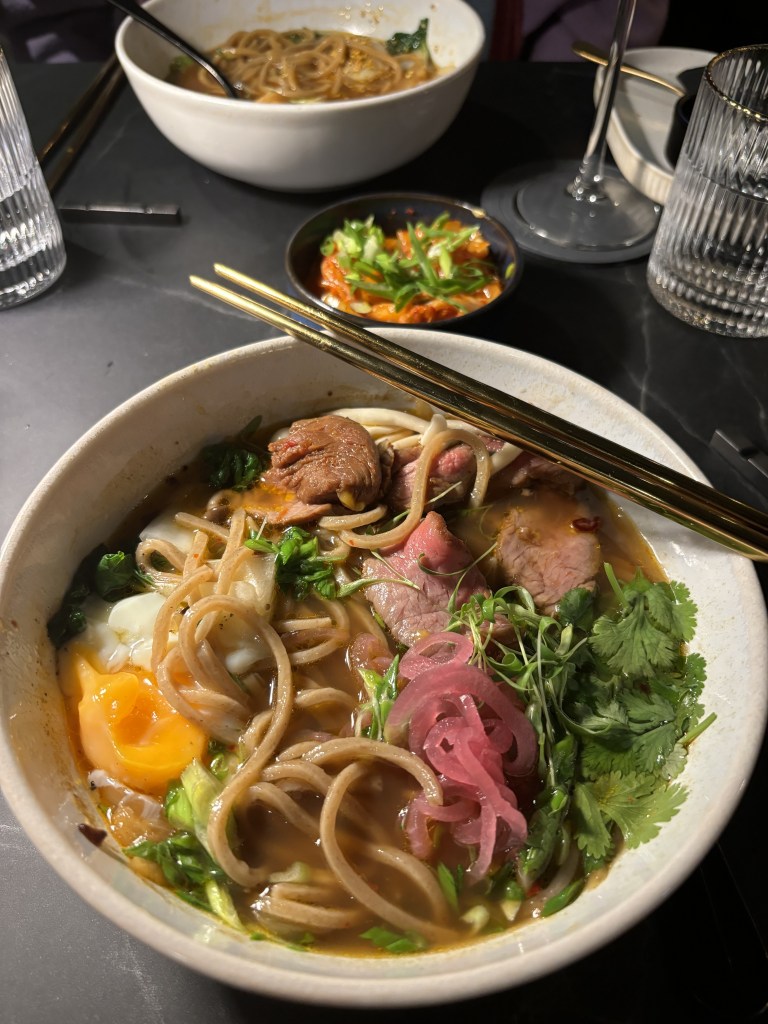
When does ramen leave the realm of the mundane and become something else? The age-old economy and food conveyance of students and struggling proletarians says “I am ready to move on, to be elevated.” Here at Kolm Sibulat, or 3-Onions, three Russian chefs have taken their ramen artistry to new heights. And so too, your budget, where versions of scallop (rear) and beef (foreground) ramen reach $25. Yet, the journey is other worldly. Fresh hand-made noodles, premium beef or seafood, rich broth. The home-made kimchi, where sweetness marries heat, much to my palate’s pleasure, brought wonderment, and requests for more. “Let go,” I told myself, “Allow yourself to be carried away.” And I was. The most delicious ramen imaginable.
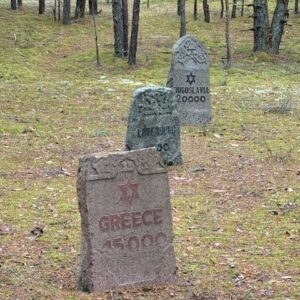
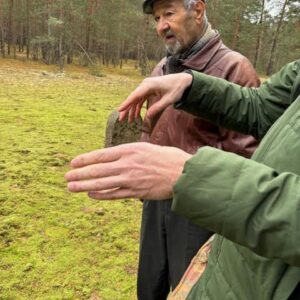
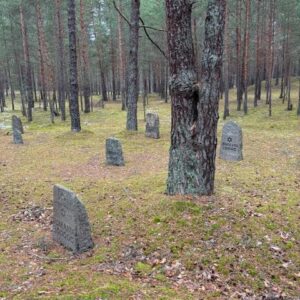
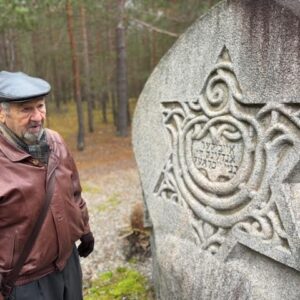
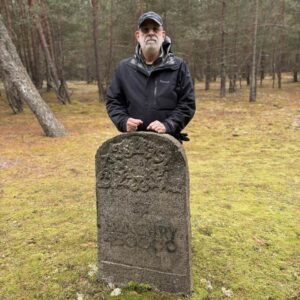
One of the most precious gifts we receive as State Department English Language Fellows is the opportunity to visit off-the-beaten-path places that lie at the heart of a place’s history and culture…Such was my experience yesterday in a sparse forest just west of our little city of Daugavpils, Latvia. We were introduced to this Memorial to all the Jews killed in Europe, by Anatoly Fishil, 87, a respected local civic leader and member of the small Jewish community here. Each country is represented by an 18th-century headstone of a Jewish person, whose own grave had been bulldozed-over by the former authorities here. Our guide personally created this memorial in 1991, 33-years to the day of our visit. We stood here yesterday, cold, awe-struck and emotionally humbled. Anatoly has his own amazing story of origin, survival, and, as this Memorial implies, incomparable generosity.
Anatoly Fishil, 87, a Daugavpils civic leader and Jewish elder, guides us at the forest Memorial17th Century Jewish headstones were saved from a demolished Jewish cemetery and given a new life hereMr. Fishil, describes the history of the Memorial he created in 1991, by sharing one amazing story after anotherA somber moment for me; this headstone reads “Hungary 450,000.” That’s the number of Hungarian Jews killed in slightly over 4-months, just before the end of World War II










 Short Talks Through a Wide World