“That’s What It’s All About”

The Hokey Pokey (Song for kids)

You put your right foot in

You put your right foot out

You put your right foot in

And you shake it all about

You do the Hokey Pokey and you turn yourself around

That’s what it’s all about
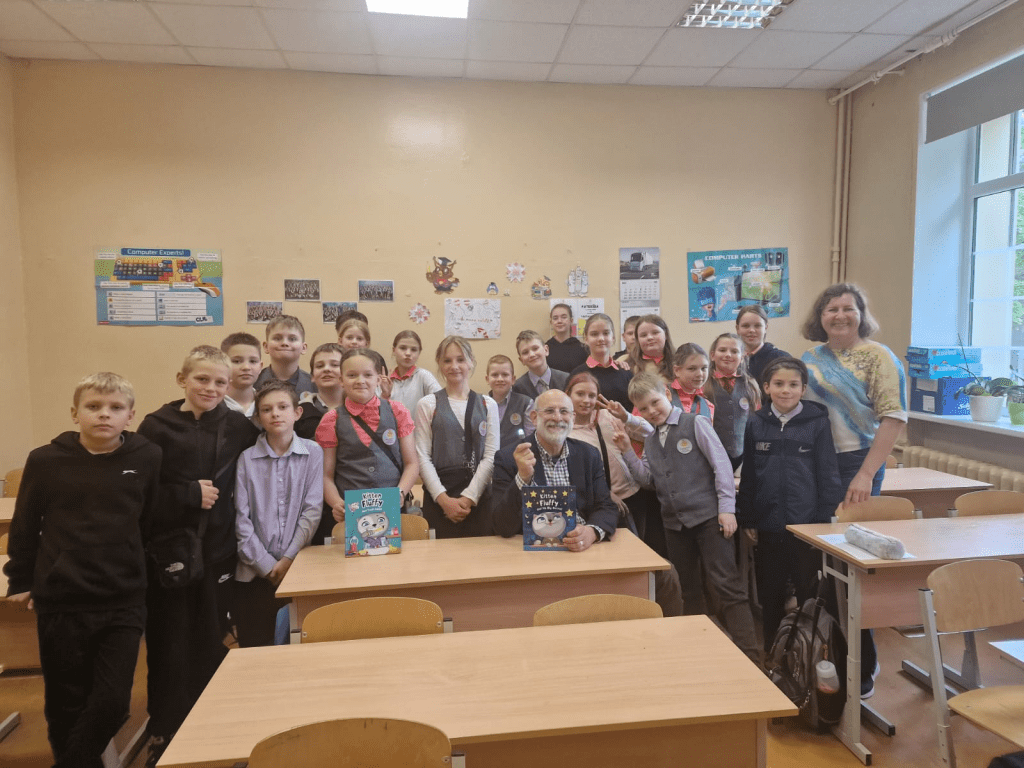
Alla, pictured right, teaches this 4th Grade class here in Latvia. She was a student of mine in a specially designed “Advanced English” class for local English teachers. She invited me to come to her class and read to her students.

English Language Fellows (ELF ) work worldwide for the U.S. State Dept. We are, lifting a marketing phrase used by the Peace Corps, doing “the toughest job we’ll ever love.” Figuratively, we’re “soft diplomats.” Nothing could be closer to the truth. Every time we step into a classroom we represent the United States, whether it’s explicit, like when the State Department logos are pasted onto the first slide of all our PowerPoint presentations. Or, on the other hand, as I lead an informal English discussion group during the lunch hour and we loosely discuss topics such as traveling abroad or the success of the Latvian film Flow winning an Academy Award for best animated film. We are inevitably seen as representatives of the U.S. and what we convey, even what may be inferred by the locals, carries weight.

We “do the Hokey Pokey” day-in and day-out, by teaching classes at our assigned university or giving presentations at the local American Information Centers, usually funded by the respective country’s U.S. Embassy. But we also get countless requests by English teachers in the local community to come to their classes to be, as they say in baseball, utility players. Depending on the age of the students, your role as a guest speaker might include giving a presentation on the U.S. Education System, or reading a story about Fuzzy The Cat who thinks there’s a monster under his bed.

Yesterday, I kept a commitment I had made weeks ago to one of my students, Alla, a 4th grade English teacher here in Latvia. While attending one of my classes, Advanced English, designed for English teachers like herself, she asked, somewhat haltingly, if I could come into her class and read to her students. I never say “no.” And as we got things going in her classroom, I thought I would break the ice, by asking the students if they had any questions for me–it’s a quick way too of assessing the English-speaking ability of the group. After asking me what my favorite countries were (I said, South Korea and Hungary, after the U.S., of course), one student said she could say hello in Korean. “Gam-sahab-nida,” she said, with near perfect pronunciation. Then, in quick succession, a smaller boy said he could count to ten in Korean. Teacher Alla, sitting quietly in the back of the room, taking photos, looked shocked. And the young boy starting counting from one to ten, also with perfect enunciation. “Where did you learn to speak Korean?,” I asked, with genuine curiosity. “I take Taekwondo,” he said, with a proud smile. These priceless revelations all taking place before I had even started reading to the class.

These are the sweet moments, the places “in between.” The interludes not necessarily planned or assigned. And to an American English Language Fellow, dancing the Hokey Pokey on any given day, somewhere in the world, that’s really what it’s all about.

Standard

Lydia

“Humility is the light of understanding.” John Bunyan

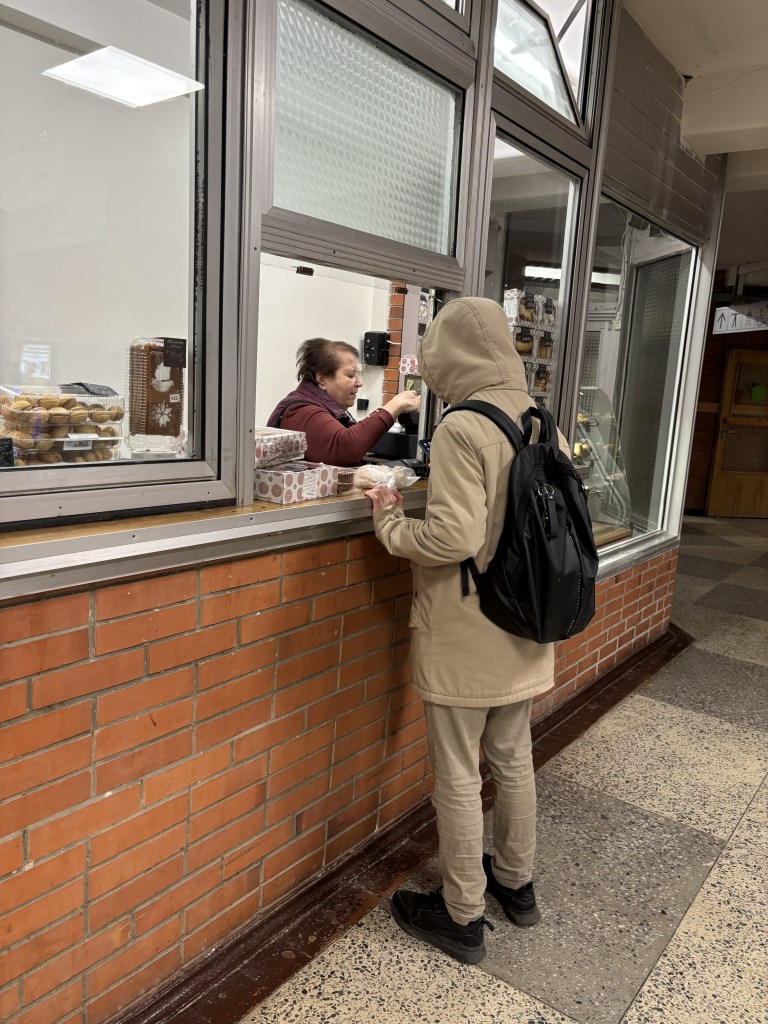
It’s a quiet dance. She listens to my request, dutifully leaves the window to make my coffee and to heat my Latvian snack in the microwave. I hear the timer ring in the distance and she returns to calculate my bill. I seek to embellish our brief time together as passengers on this twice-weekly routine, by asking how her day is going.

Brick by brick, exchange by exchange, I am building a social cottage here. A few people, like Lydia, help piece it all together. Her slight smile, her friendly voice, are the mortar that help hold it all together. I know I could easily leave it like that: comfortably anonymous and perfunctorily routine. But then, I’ll miss learning something more, about Latvia, about this place, about Lydia.

So I ask if I can speak to her sometime in the days ahead-an interview of sorts, I say. She agrees, and I wonder if she understands my request.

Lydia was born 62 years ago in the tiny hamlet of Faltopi about 30 kilometers southeast of Daugavpils. It is near the Latvian-Belarus border. She was an only child, she tells me, as was her husband of 42-years and their daughter, Inesa.

Inesa, though, changed all that, having 5-children. She moved to the UK, leaving the country, as a number of younger Latvians do, seeking opportunities and higher paying jobs elsewhere. When I learn that Inesa’s eldest daughter, Ustina, is in dental school, I say with some certainty, “Oh, you must be very proud.” A huge smile envelops Lydia’s face.

Lydia serving a student at the campus canteen where she works
weekdays from 8:30 – 4:00.

With her grandchildren living in England, Lydia likes to practice using her English-luckily for me. Latvians are highly literate (99%+) and well-educated. Lydia graduated from Riga Polytechnic University, majoring in building and architecture. It’s her interest, she says, in meeting and speaking with others, that brings her to this canteen window, a portal for brief exchanges of food, beverage and conversation.

This semester I visit Lydia’s building on Mondays and Wednesdays where I lead lunchtime English conversation classes. Knowing she’s here, that I can say hello, ask how she’s doing, adds something intangibly meaningful to my day. And Lydia, was my mom’s name.

Lydia and I share a history now, a place in time and space. She is not part of the official curriculum I offer my English students, and won’t be mentioned in a written report to the US. Embassy, or to program contacts in Washington, D.C. But meeting Lydia is exactly why I am here, teaching in Latvia.

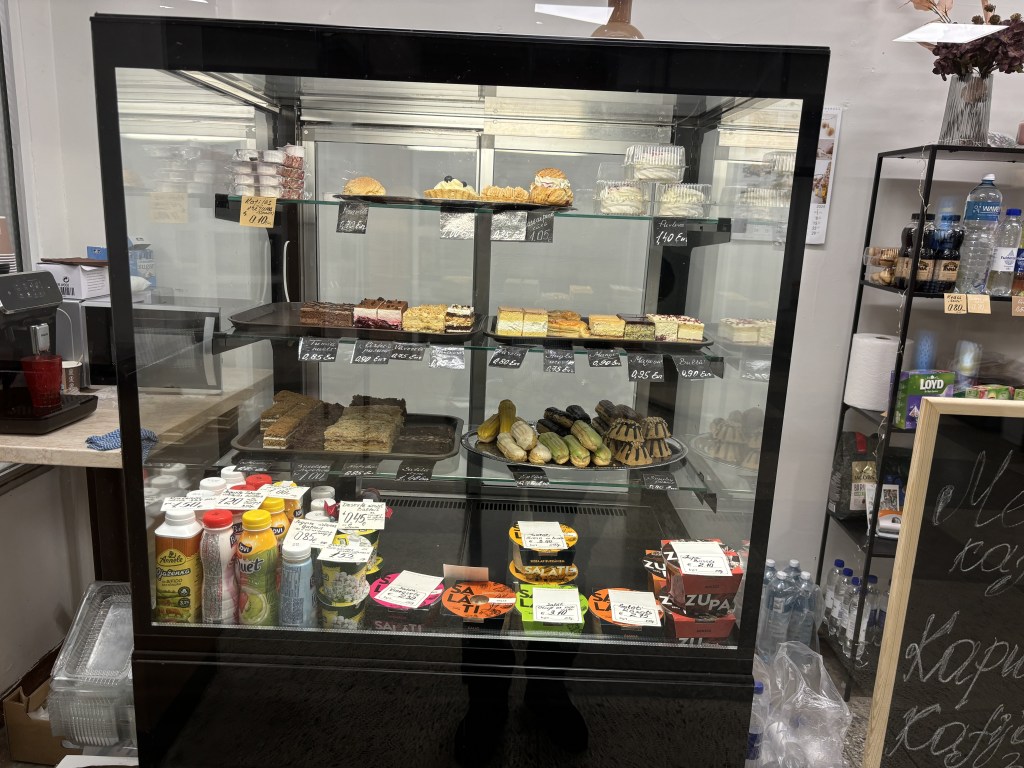
Sweets served-up by Lydia.

Standard

A Powerful Memorial Stands in a Quiet Forest in Eastern Latvia

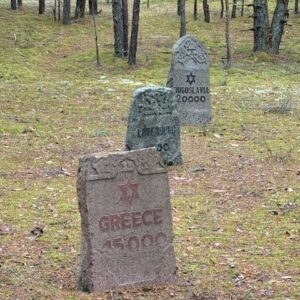
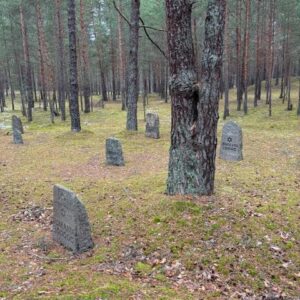
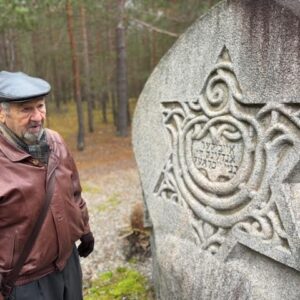
One of the most precious gifts we receive as State Department English Language Fellows is the opportunity to visit off-the-beaten-path places that lie at the heart of a place’s history and culture…Such was my experience yesterday in a sparse forest just west of our little city of Daugavpils, Latvia. We were introduced to this Memorial to all the Jews killed in Europe, by Anatoly Fishil, 87, a respected local civic leader and member of the small Jewish community here. Each country is represented by an 18th-century headstone of a Jewish person, whose own grave had been bulldozed-over by the former authorities here. Our guide personally created this memorial in 1991, 33-years to the day of our visit. We stood here yesterday, cold, awe-struck and emotionally humbled. Anatoly has his own amazing story of origin, survival, and, as this Memorial implies, incomparable generosity.

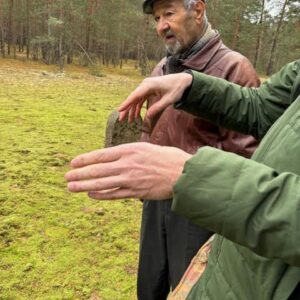
Anatoly Fishil, 87, a Daugavpils civic leader and Jewish elder, guides us at the forest Memorial
17th Century Jewish headstones were saved from a demolished Jewish cemetery and given a new life here
Mr. Fishil, describes the history of the Memorial he created in 1991, by sharing one amazing story after another
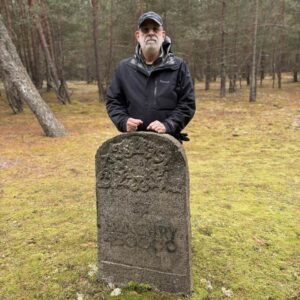
A somber moment for me; this headstone reads “Hungary 450,000.” That’s the number of Hungarian Jews killed in slightly over 4-months, just before the end of World War II
Standard