
Our Leaders’ Lack of Empathy and Contact With the Real World is Contributing to the Failure of American Politics

“Let them eat cake!,” a quote famously attributed to Marie Antoinette, is likely, according to many historians, not something she actually uttered. It more often can be considered a journalistic cliche. But it has, undeniably, become a slogan suggesting just how callous and out of touch leaders can be. More likely, Antoinette, was part of an aristocratic class unwilling to relinquish their financial privileges, including gambling and garish spending on jewelry and furnishings. We might be intrigued to know of the rumors that she plastered the walls of her chateau with gold and diamonds. Rumors aside, our current White House resident, one Donald Trump, has unabashedly adorned the walls of his residence with assorted gold fixtures and accessories-all while support for children’s food programs and health-care go unfunded.
:max_bytes(150000):strip_icc():focal(749x0:751x2)/Donald-Trump-speaks-as-he-meets-with-Italian-Prime-Minister-Giorgia-Meloni-in-the-Oval-Office-042125-7c88560f5c1247ec9e0e84401a4cf3c3.jpg)
I, for one, want my representatives to know not only what the inside of a grocery store looks like, but more importantly, what it means to struggle with the highest ground beef and coffee prices in decades. I demand that politicians know what it’s like to have worked for a minimum wage, mopped the floors in a restaurant, and to have ridden on public transportation. These experiences would, by necessity, help these folks understand the challenges that most Americans face day-to-day. And they might help them develop the empathy, humility and understanding essential when developing policies and advocating for their constituents.
Say what you will about Bronx-born U.S. Congresswoman Alexandria Ocasio-Cortez, but after graduating from Boston University, she worked as a waitress and bartender. Recently elected New York City mayor, Zohran Mamdani worked, not too long ago, as foreclosure prevention and housing counselor. In that job he helped lower-income immigrant homeowners in Queens with eviction notices and efforts to prevent them from being evicted from their homes. He claimed that “the experience motivated him to run for office to address the housing and affordability crisis.”
While we may not be able to require candidates running for office to have had such real-life experiences, I suggest supporting those who have worked in the real world. It’s humility, empathy and an understanding of the experience of average Americans that’s dangerously lacking from Trump and just about everyone in his administration. Just this week, he vetoed a bill that would have ensured clean drinking water for 50,000 people living in southeastern Colorado. His water, I suppose, likely flows from golden spigots whenever he’s thirsty.
This past week we learned of the passing of Tatiana Schlossberg, 35, granddaughter of former President John F. Kennedy. While struggling with leukemia, she spent many of her final months confined to the hospital. After receiving a stem cell transplant, her hair fell out. In a show of solidarity and compassion, her younger brother, Jack, shaved his head. And to prove that empathy knows no age, her young son wore a scarf to cover his head when visiting the hospital, as his mother needed to do.
At nearly the exact same time, Trump was making light of the murders of Rob Reiner and his wife, Michele. After a lifetime of racist theatrics, including preventing Black New Yorkers from renting apartments in his father’s apartment kingdom, and demanding the death penalty for 5-young Black men who were unfairly accused of beating and raping a jogger in Central Park, Trump now focuses his racism on America’s Somali population, amongst other groups.
Familiarity doesn’t necessarily breed contempt as the old proverb says, but in actuality, it encourages empathy and humility. We must demand representatives who know and value both. And while Marie Antoinette may never have uttered those exact words, “Let them eat cake,” Trump’s gilding of the White House and destruction of the East Wing-all while many American’s wonder how they will financially survive 2026, is much more dangerous than just words.
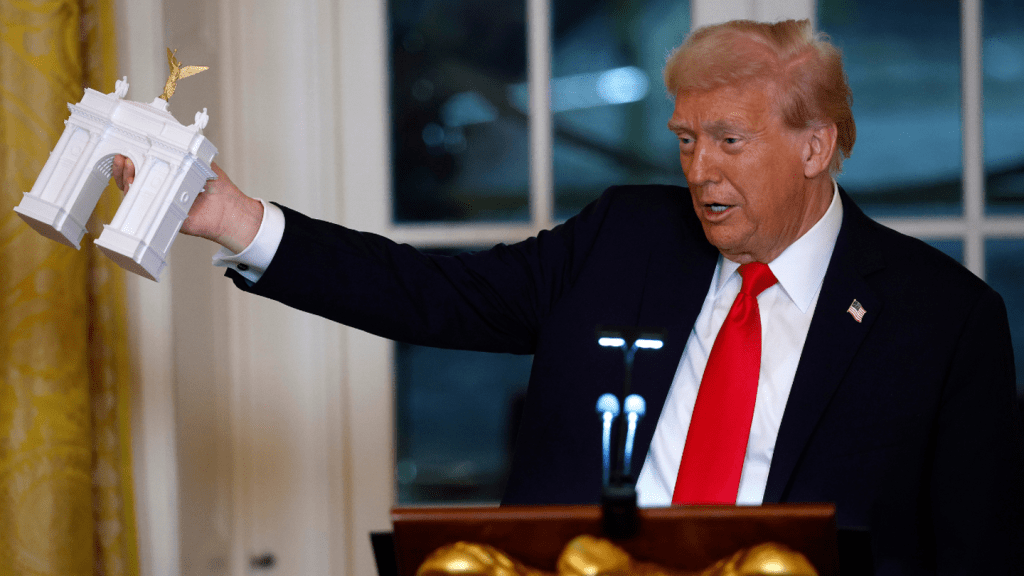
And, as if icing on an already obscene cake, Trump has announced the building of a Triumphal Arch, modeled after the famous French Arch, and already nicknamed the Arc de Trump. It symbolically portends the end of compassion and justice in our political system-the end of the political world as we know it.
One can be both privileged and compassionate, affluent and empathetic, famous and yet humble. We must demand more from our political leaders.









 Short Talks Through a Wide World