There’s a kind of privilege to this circle. From a remote, little known community in Latvia, to a city on America’s west coast known for its roses and weirdness, I have followed the unlikely path of artist Mark Rothko.
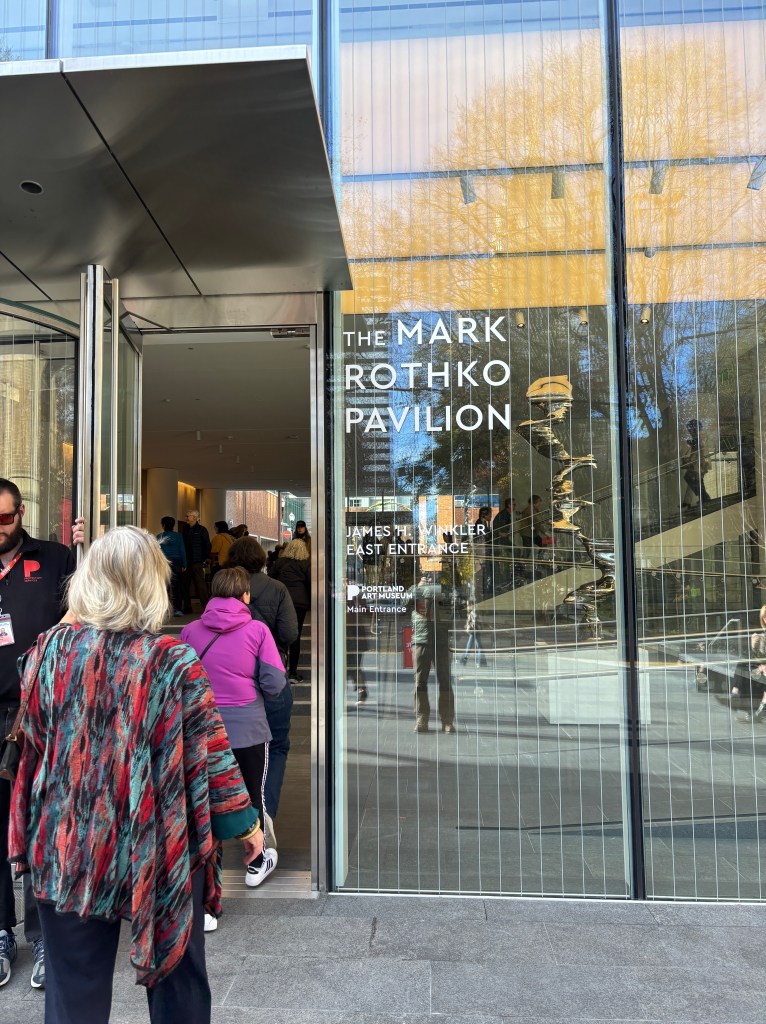
The opening of the new Mark Rothko Pavilion at the Portland Art Museum in Portland, Oregon
Part of the Russian Empire at the time of his birth, Daugavpils, Latvia, today is a quiet city only a few minutes from the Russian border, pot-marked by a surprising number of empty buildings. Riga Street, the local equivalent of Main Street, stretches for a half-dozen blocks from the university to the train station. Russian-style apartment buildings fill most of the side streets. But at the time of Rothko’s childhood, Daugavpils was a larger, more vibrant city, filled with many small, Jewish-owned businesses. One could find a Jewish synagogue on almost every block. And it was in this 1910 tableau of far western Russia that we find the family of Mark Rothko.
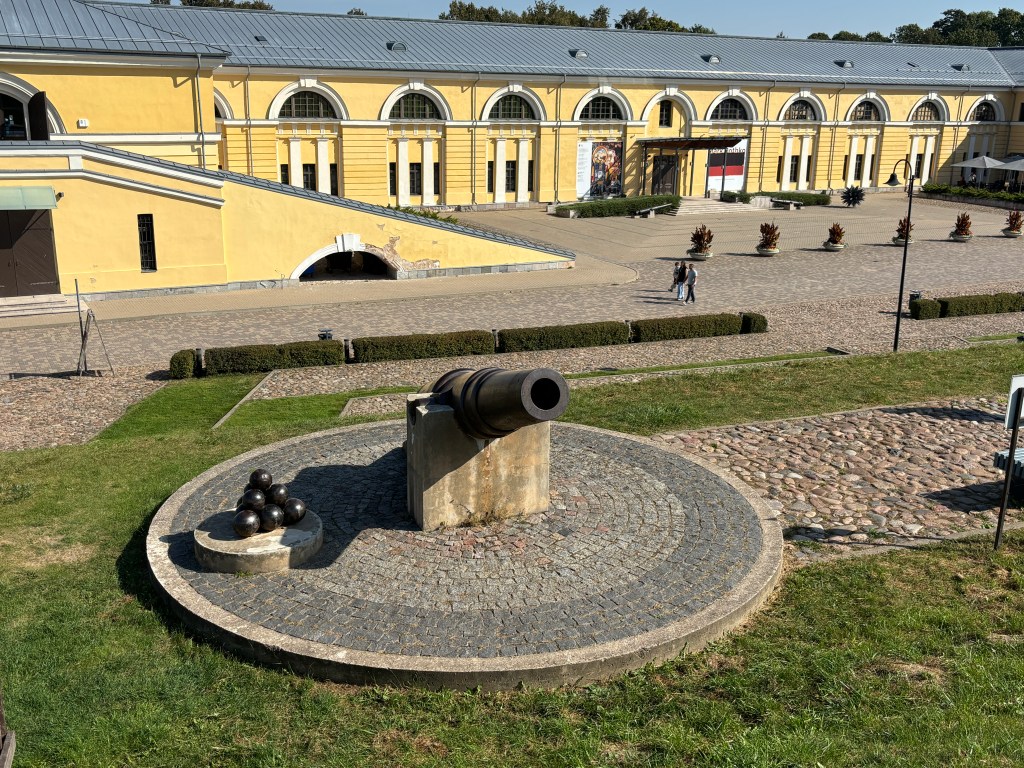
The Mark Rothko Art Center in Daugavpils, Latvia
When his father received notice that he was about to be drafted into the Russian army, he departed for the U.S. His oldest sons too, would be ripe picking for service in the Russian army. So Rothko’s father first departed in 1910 and the rest of the family followed shortly after. Train rides clear across the United States brought the family to Portland, Oregon. Rothko attended high school in Portland and later studied art at Yale University on the U.S. East coast in New Haven, Connecticut. Shortly after, he settled in nearby New York City, joining the spirited art community there.
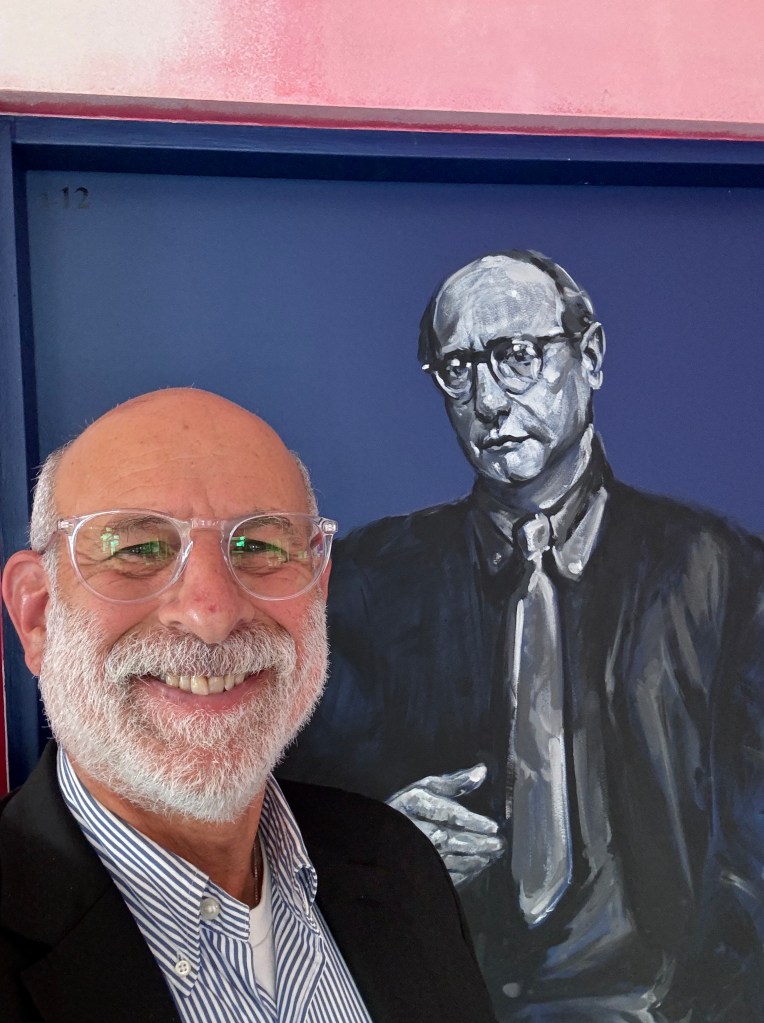
A likeness of Mark Rothko at the U.S. Information Center in downtown Daugavpils, Latvia. I gave a series of travel-themed public workshops in that venue to help support English language skills in the community.
Serendipity introduced us to Mark Rothko. This past year an assignment by the State Department took me to Daugavpils University as an English Language Fellow. Perhaps the most interesting stop in that city is the Mark Rothko Art Center which we visited every few weeks. Two or three Rothko pieces were displayed on rotation regularly, while local artists were featured in varying accompanying exhibits. We loved the museum, a relative oasis in an otherwise quiet city of 70,000.
According to Wikipedia, works by Rothko continue to regularly achieve prices at auction ranging as high as $80 million
Months later we are spending much of the winter here in Portland, Oregon, visiting our son and his young family. It’s here that we witness the opening of the new Mark Rothko Pavilion in that city’s Portland Art Museum. A number of his signature pieces are on display. His striking work draws viewers like magnets. We had prints of his work on the walls of our flat in Latvia and they do nothing less than pull you in to their box-like flashes of color.
At the November (2025) opening of the Mark Rothko Pavilion in Portland, Oregon
How does one view them? “Like a sunset,” is one interpretation I like. And like a sunset, there’s nothing much to explain. Just let yourself go and drift along amongst all the fascinating possibilities. Here’s a video that may provide some helpful scaffolding. Perhaps you’ll be introduced to this Mark Rothko for the first time.
Who will bend this ancient hatred, will the killing to an end? Who will swallow long injustice, take the devil for a country man? Who will say “this far no further, oh lord, if I die today?” Send no weapons no more money. Send no vengeance across the seas Just the blessing of forgiveness for my new countryman and me Missing brothers, martyred fellows, silent children in the ground Could we but hear them could they not tell us “Time to lay God’s rifle down.” Who will say, “this far, no further,” oh Lord, if I die today?
Belfast to Boston, James Taylor, from the album, October Road
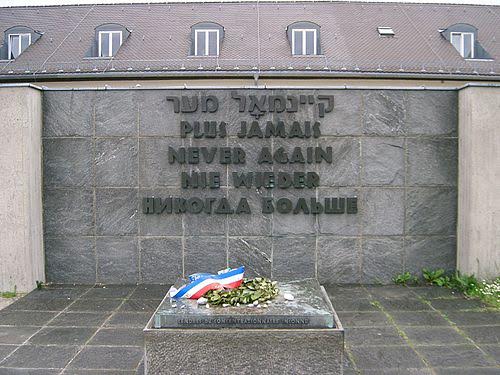
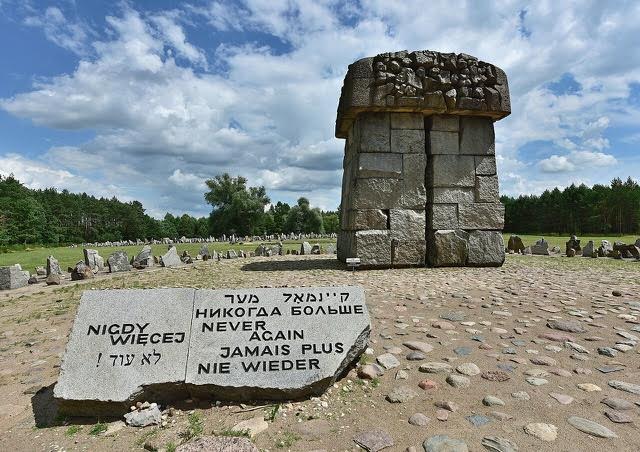
“Never Again” in 5-languages
“Never Again” was an expression we heard over and over again as children-even in my non-religious household. They were words on the wind in Hebrew Schools, during religious holidays, even along the non-sectarian stretches between holidays. We should never forget, could never forget, the Holocaust, but even more, we committed ourselves to never allow such a horrific tragedy to take place again.
An unparalleled tragedy it was. Having lived in both Hungary, and Latvia, I have come to appreciate the relatively recent dark-era of Jewry in Europe that occurred during the 1st half of the 20th century. During the last 4-months of WWII, 600,000 Hungarian Jews were rounded up and hurried off to Nazi death camps. Daugavpils, the 2nd largest city in Latvia, was almost 60% Jewish, as recently as the 1920’s. At one time, the city had more than 50-synagogues. Many Jews were taken prisoners by the Nazis and shot in the surrounding forests and dumped into mass graves. Today, there is one remaining synagogue and a Jewish population in the hundreds. This was the angst of the holocaust. We said, “Never again.”
Yet, we watch a genocide underway in Gaza. The State of Israel, following the lead of Netanyahu and his Right-wing government, is destroying the Palestinian State, its society and its people. Israel, long heralded as the only democracy in the Middle East, is rolling out the unthinkable, a never ending death carpet of bombing, destruction, killing and assassination.
“Never Again.”
Defenders of Israel say any criticism is antisemitic. If you criticize Israel, they claim, you are standing against Israel and the Israeli people. But this is problematic to the core. What if one believes that the destruction of Gaza and its people is against the best interests of Israel? What if a reasonable person believes that the destruction of Gaza ensures generations of hatred against Israel? This perspective sees Israel through the eyes of young Palestinian youths who are witnessing the incessant destruction of the world as they know it. How could this possibly be good for Israel’s future?
Never again is happening again. But this time, Jews are not the object of the hate and death, this time, the Israeli establishment is the subject. They are the exterminators.
This truth in no way justifies the actions of Hamas on that horrible day, October 7, 2023. That day, resulted in the deaths of 1,200 people and the taking of about 250 hostages. That day will live in infamy.
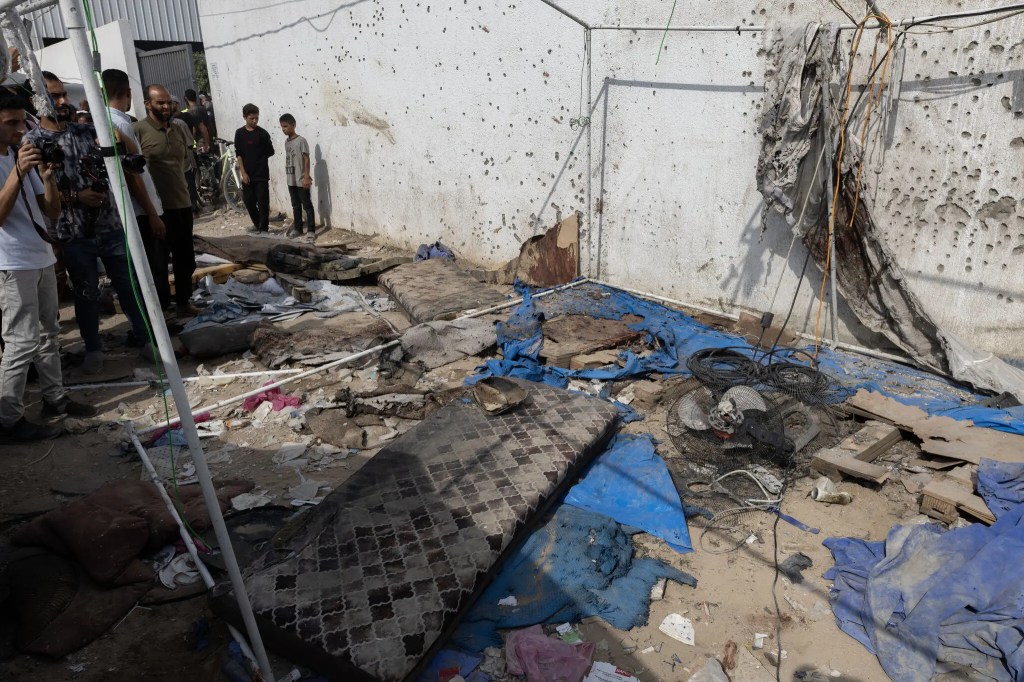
In Gaza, 61,722 Palestinians, mostly women and children, have been killed since that day in October, according to the Gaza Ministry of Health ( MoH). A joint World Bank and UN assessment estimates that around 70% of all the structures in Gaza have been damaged or destroyed as of August, 2025. Furthermore, they report that 81% of the roads have been destroyed or damaged, 68% of agricultural land has been damaged, 84% of health facilities have been damaged or destroyed. Finally, almost all the children of Gaza are out of school.
This was the scene recently where the Israeli army attacked 5-Palestinian journalists, claiming one worked for Hamas. They provided no evidence to back this claim. (Photo courtesy of the New York Times)
This is not a game of semantics. But let’s be clear. Genocide is “an act committed with intent to destroy, in whole or part, a national, ethical, racial or religious group.”
Never again. What they must have meant by “Never Again” all this time was never again to Jews. As the world is convulsing politically no one seemingly has the time or inclination to demand: This far, no further. Treating this racism, this genocide, as a typical or minor matter indicts us. We need a domino effect of clarity and courage to end this insanity. It’s way past time to lay God’s rifle down.
It sounds almost whimsical, if not straight-up naive. The U.S. State Department told us, in so many words, “As an English Language Fellow, living and teaching overseas, you’ll be engaging in ‘Soft Diplomacy’ on behalf of your country.”
The “Old Building” on the campus of Daugavpils University
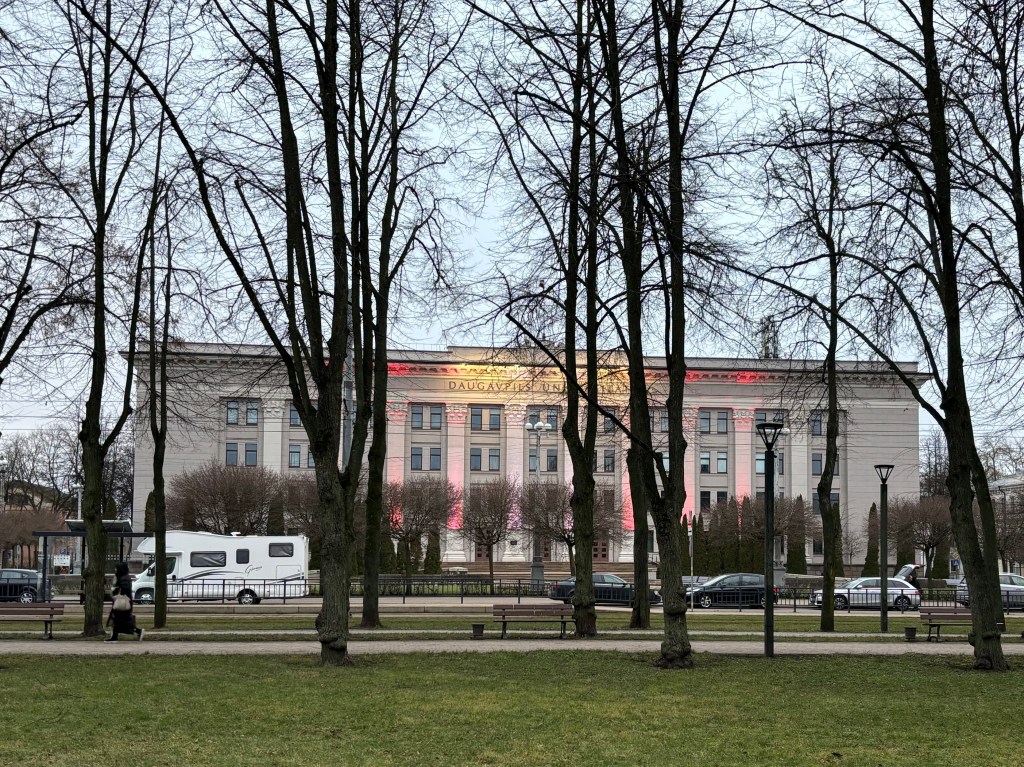
Yesterday, after a 10-month stint teaching at a university in a remote city, here in Latvia, I found myself walking through a park here in Riga at about dusk. I was in a reflective mood, leaving Latvia as I am, early tomorrow morning. Twilight, I find, is the time when taking photos is best–the light is perfect for clarity, for colors, and for capturing the “essence” of things. It feels like an apt metaphor for my year here–I was somehow able to capture and appreciate the essence of my relationships with students and colleagues. It was a year of relationships, rather than simply transactions. Latvians, I’ve come to learn, see themselves as a bit distant at first, slow to connect with others. But once they do, they really make those connections real.
The Economic Challenges Here
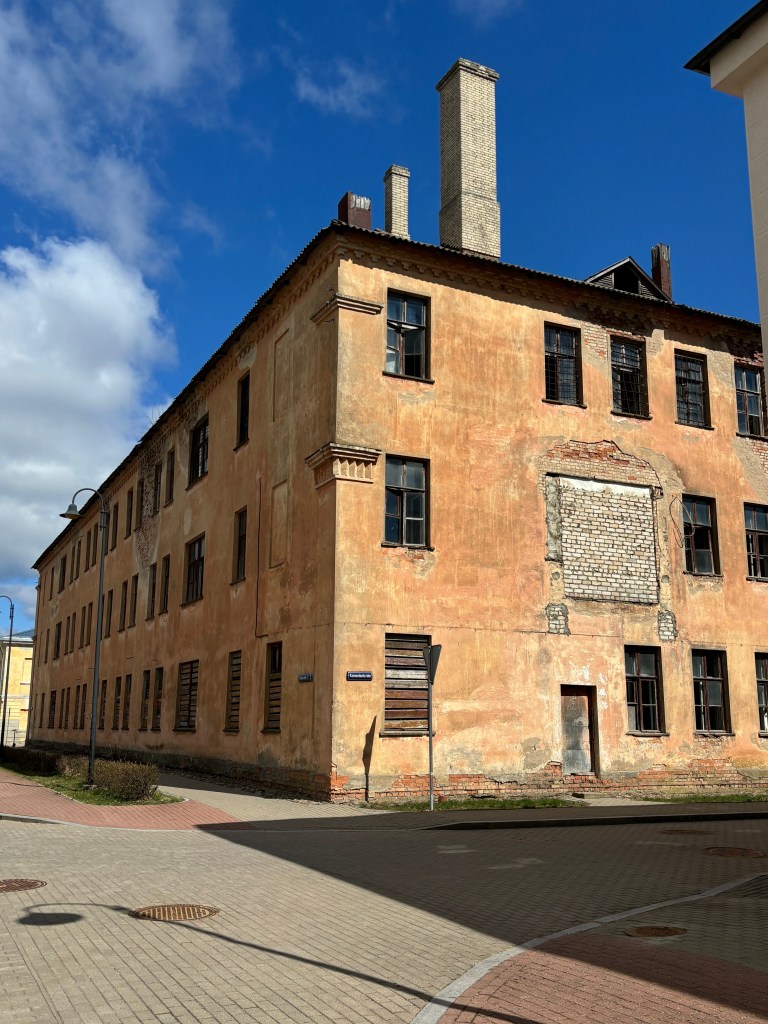
And, keeping it real, we should talk about the economy here. These days, Latvia’s economy seems stalled, taking a backseat to the other two Baltic States, Estonia and Lithuania. Yes, the capital, Riga, does feel upbeat and vibrant. But for the country overall, that’s a chimera. My home city here, Daugavpils, far to the east near the borders with both Belarus and Russia, is watching its population decline, and has been for years. The handsome city, while dignified and proud, is dotted with abandoned buildings. In 1993 when the Soviet Union withdrew, factories began closing. Many locals felt that the E.U. didn’t want the cheap competition that Latvian production offered, so rather than investing in a sustainable economy, they started sending Euros to largely pacify the locals. This did little to build a Latvian economy for the long run.
An abandoned building within the City’s historic Fortress. There are many throughout the city
Meanwhile, Estonia, just to the north, historically more aligned with Finland and the rest of Scandinavia, saw their economy take off. Lithuania, bordering on Latvia’s south, is currently, by most accounts , experiencing an economic renaissance. It’s vibrant capital city, Vilnius, was named “Europe’s Green City for 2025,” recognizing its progress along environmental criteria such as: increased miles of bike and pedestrian paths, hotels that have met strict environmental standards, and park expansions. Lithuanian “youth,” the group of citizens 30-years old and younger, have been rated as the “happiest” youth cohort in the world for the 2nd straight year, according to the World Happiness Reportpublished by the United Nations.
I’ve repeatedly queried my Latvian friends about these economic differences amongst Estonia, Lithuania and Latvia, natural bedfellows as they are. While their answers are nuanced, there is an unmistakable theme: in the end, the cultures and the people are quite different. While the Estonians have historically looked north toward Finland, and Lithuanians gazed west toward Germany and Poland, Latvia peered eastward toward Russia, and as a result, the culture has been largely influenced by that country. Well, what does that really mean? What are the consequences of having been more aligned with Russia and the Soviet Union all those years?
One answer came from one of my students this year–let’s call him Rich. Rich is a bit older and more experienced than my other undergraduate students who are mostly in their late teens and twenties. He had once lived in the Chicago area for 6-months. What struck him profoundly, he recalled, was what he observed taking place after snow storms. He noticed that municipal vehicles immediately came by to efficiently plow the snow from the streets, then shortly after the plowing, residents armed with shovels, diligently cleared their driveways and sidewalks. OK, I wondered, so what’s unusual about this? But Rich continued. You’d never see residents here grab their shovels and in civic-unison take care of removing snow from their homes and sidewalks. Instead, he said, they would be sitting around waiting, complaining and criticizing their government for lack of action. It was, he explained, more of a Russian-style approach to dealing with civic matters: watching, waiting for someone to come do something, and then complaining…
Not a few Latvians have criticized their own culture as the key obstacle to turning their economy around. The complaining and concomitant lack of action is one challenge, but so too is what they perceive as graft. E.U. funds, which come in massive amounts to support projects like train systems, highway modernization and other development initiatives, get siphoned into the pockets of politicians and cronies at every turn. This apparently is well-known by nearly everyone I spoke with. Moreover, many Latvians say, it is at epidemic levels in Latvia–far worse than in either Estonia and Lithuania where, they say, more of the money from the E.U. actually gets to the projects they were earmarked for.
Daugavpils, Latvia’s 2nd Largest City
You get a predictable reaction from many Latvians, most often one of subtle condescension, when you mention the city of Daugavpils. They seemingly judge the 80%, or so, of the area’s ethnic Russians, and Russian speakers, as “a problem.” In actuality, as bigotry often proves to be when “poked-at” a bit, the people of Daugavpils are almost always, in turn, welcoming, kind, curious and appreciative of having an American in their midst.
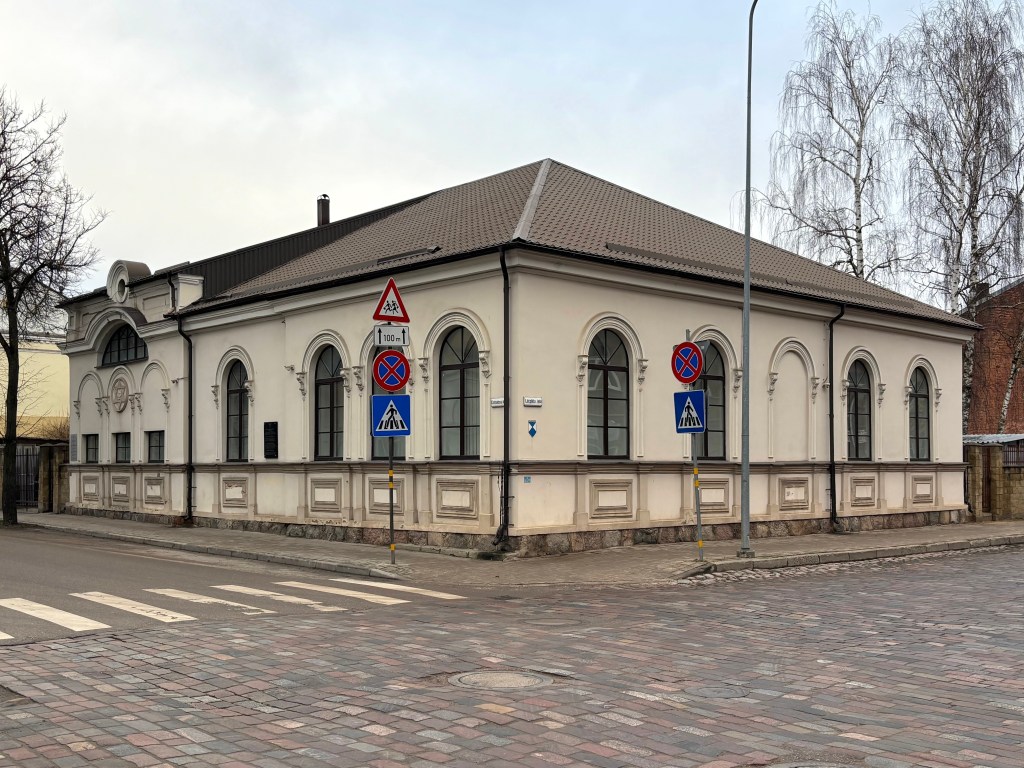
But there was one boundary that my understanding could never seem to cross. Whether it was cultural, existential, language-related, or a combination of factors, I’ll never know for certain. That is, how people really feel about the loss of their Jewish residents during the first half of the twentieth century. Jews, during that era, once comprised almost 60% of the local population. In fact, the city of Daugavpils boasted 55-synagogues of various sizes. There must have been at least one on every block. The main Street, Riga Street, was mostly comprised of Jewish-owned shops on both sides of its quarter-mile commercial stretch. But, that’s all a distant memory today and Jewish places of worship are now down to one solitary synagogue–sitting handsomely and proudly, as it does, on a quiet corner in the middle of the city.
The last remaining synagogue in Daugavpils
That somewhat tragic historical chasm aside, Daugavpils is a comfortable, almost seductive, place to live. The general kindness and support of the people there were not lost on me. Like the quiet trams that criss-cross the city, my comings and goings invariably went smoothly and without incident. Some of this social “seamlessness” was, no doubt, a reflection of my own approach and experience. Having previously spent extensive time living and teaching in South Korea and Hungary, and traveling through nearly 80-countries (but who’s counting?) has helped me avoid behaving like the “Ugly American.”
Final Reflections
The lion’s share of what made my time in Daugavpils so pleasurable and rewarding was, no doubt, due to the Latvians themselves–their kindness, consideration and pride–the latter being particularly unmistakable. Latvia is, in fact, a beautiful place, a country of hundreds of lakes and endless forests, of rich traditions and countless hopes, many of which. for Latvians, remain frustratingly unfulfilled.
“I found the method both creative and deeply meaningful, and it offered a refreshing perspective on how emotional values can be integrated into language teaching.” -Latvian English Teacher
“…unlike any traditional language teaching activity I had encountered before. Based on a conceptual art project, the session introduced the idea of using personal items that hold emotional value as a basis for classroom interaction. Students bring in meaningful objects, write emotional statements about them, and participate in an ‘auction’ by bidding with their own reflections. I found this approach fascinating as it blends reading, writing, speaking, and listening skills in a highly personal and emotionally engaging way. It encourages students to be vulnerable, empathetic, and expressive—qualities that are often underdeveloped in language classrooms.” -English Teacher in training from Turkey
“I was really inspired by your Emotional Values Auction idea…It was absolutely awesome! You were able to make me think about those aspects that have remained in the shadows to this day.” -Estonian English Teacher
“The Emotional Values Auction” was not just about giving away objects but it was about sharing pieces of the heart. That made it truly unforgettable. It showed me that emotional value can often outweigh material worth, and that the act of giving can be even more meaningful when it’s based on understanding and empathy.” – Undergraduate Education student from Turkey
Introduction
An Emotional Values Auction (EVA) is a new, unique, and innovative methodology for teaching English. Based on a conceptual art process originally conceived of by Portland, Maine (USA), artist Adriane Herman, it replicates the structure of an actual auction. The process incorporates student skill development in the areas of writing, listening, reading, speaking and presenting. The context is both cognitive and emotional, as the students consider items to submit to an in-class auction that represent their experience with, for example, the emotions of generosity, pride, happiness, or loss. Students present their items to the class and expand on their experiences by telling their stories. Other students “bid” on the items that they feel a connection to. “Bids” are made by writing about why they think they would be good stewards for receiving the items “up for auction.” The submitted “bids” are reviewed by the original student donating their item, and that person selects the final recipient. No money is exchanged. The “currency” is shared experience and learning. Students report positive levels of satisfaction with the process based on several factors.
From a Unique Art Concept to an ESL Teaching Methodology
During the summer of 2023 while a friend was visiting from out of town, he suggested we take-in an art show in Portland, Maine. We expected a typical art show, but instead, found we had entered an art experience called an “Emotional Value Auction.” In consisted of displayed items that people were “letting go of” that had emotional value to them. The items were accompanied by written statements from the owners about what the item meant to them, and why they felt it was time to “let it go.” It was fascinatingly eclectic, that is, it included items as varied as a grandmother’s old flannel shirt, an antique leather diary, even an unused B-B Gun rifle from the early 1980’s.
Displaying “generosity,” an English student enters her artwork into the auction.
Because it was an auction, you could “bid” on any item if you were somehow desirous of it. A visitor to this so-called Emotional Value Auction, could submit a “bid” on any item, or multiple items, by writing a statement about why they felt connected to it. The “bids” were collected during the several weeks the auction was underway and eventually they were given to the respective person who had originally submitted the item to the auction. That person would subsequently review all the “bids” placed on their item and select the one that “moved them,” or appealed to them, the most. The item was then awarded to that person.
Another English language student after her successful bid.
I thought that this process could effectively be adapted to an ESL teaching methodology, one that helped develop the skills of reading, writing, speaking, listening and even presenting. So, I designed an approach and piloted it last Fall in two of my English classes at Daugavpils University in Latvia. The results were amazing.
Follow-up evaluations indicated that students both valued and enjoyed the process more than other learning activities they had experienced while learning English. Furthermore, and to my surprise, students reported that the Emotional Values Auction process revealed aspects of classmates they had not known previously, for example, their interests, hobbies and skills. And as a result, many felt that the class had become a closer group of learners.
Since that semester, I have implemented the EMA is several additional Spring classes. The results have been similar, that is, students report enjoying the learning process, while at the same time, enhancing their English language skills, acquiring new related vocabulary, and reporting similar group development outcomes.
Recent Developments in the Baltic States English Teaching Community
A trio comprised of two U.S. State Department English Language Fellows (ELF’s), and a Specialist, developed a so-called “Road Show,” where we offered training for regional English educators hosted by area educational institutions. We dubbed these trainings, “mini-conferences,” as the participants were offered the opportunity to attend two-workshops on a Saturday or Friday morning. The Emotional Values Auction was one of these workshops, intended to introduce the methodology to teachers and to provide a Teacher’s Guide as follow-up to interested attendees. These workshops have been offered in Wroclaw in Poland, at the University of Tartu in Estonia, in Riga at the University of Latvia, and in Daugavpils. The reception to the methodology has been highly favorable as indicated by the representative comments quoted at the outset of this post.
Alfred Mercier, a noted early American playwright, novelist and philosopher, who spoke five-languages, said, “What we learn with pleasure we never forget.” The Emotional Values Auction process seeks to combine the cognitive aspects of language learning with a focus on emotions all while providing students with a fun and memorable learning experience.
If you are an educator, or have further interest in the Emotional Values Auction process, and would like a copy of the accompanying Teachers’ Guide, please contact Steven Schuit: Schuitstephen33@gmail.com
You do the Hokey Pokey and you turn yourself around
That’s what it’s all about
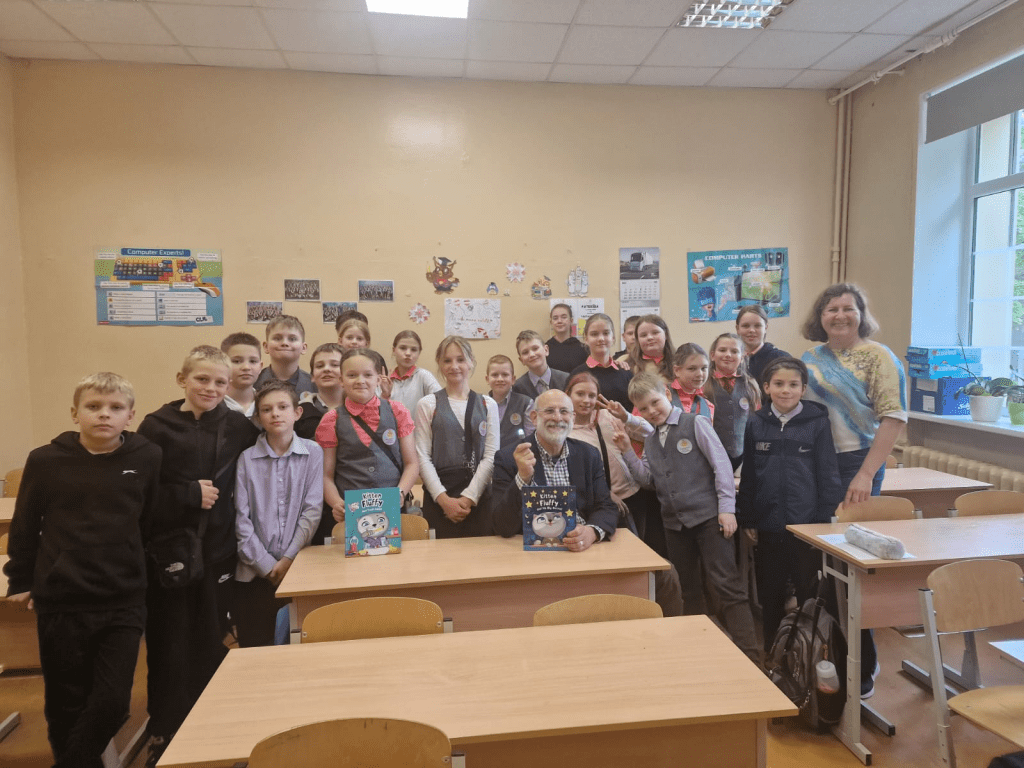
Alla, pictured right, teaches this 4th Grade class here in Latvia. She was a student of mine in a specially designed “Advanced English” class for local English teachers. She invited me to come to her class and read to her students.
English Language Fellows (ELF ) work worldwide for the U.S. State Dept. We are, lifting a marketing phrase used by the Peace Corps, doing “the toughest job we’ll ever love.” Figuratively, we’re “soft diplomats.” Nothing could be closer to the truth. Every time we step into a classroom we represent the United States, whether it’s explicit, like when the State Department logos are pasted onto the first slide of all our PowerPoint presentations. Or, on the other hand, as I lead an informal English discussion group during the lunch hour and we loosely discuss topics such as traveling abroad or the success of the Latvian film Flow winning an Academy Award for best animated film. We are inevitably seen as representatives of the U.S. and what we convey, even what may be inferred by the locals, carries weight.
We “do the Hokey Pokey” day-in and day-out, by teaching classes at our assigned university or giving presentations at the local American Information Centers, usually funded by the respective country’s U.S. Embassy. But we also get countless requests by English teachers in the local community to come to their classes to be, as they say in baseball, utility players. Depending on the age of the students, your role as a guest speaker might include giving a presentation on the U.S. Education System, or reading a story about Fuzzy The Cat who thinks there’s a monster under his bed.
Yesterday, I kept a commitment I had made weeks ago to one of my students, Alla, a 4th grade English teacher here in Latvia. While attending one of my classes, Advanced English, designed for English teachers like herself, she asked, somewhat haltingly, if I could come into her class and read to her students. I never say “no.” And as we got things going in her classroom, I thought I would break the ice, by asking the students if they had any questions for me–it’s a quick way too of assessing the English-speaking ability of the group. After asking me what my favorite countries were (I said, South Korea and Hungary, after the U.S., of course), one student said she could say hello in Korean. “Gam-sahab-nida,” she said, with near perfect pronunciation. Then, in quick succession, a smaller boy said he could count to ten in Korean. Teacher Alla, sitting quietly in the back of the room, taking photos, looked shocked. And the young boy starting counting from one to ten, also with perfect enunciation. “Where did you learn to speak Korean?,” I asked, with genuine curiosity. “I take Taekwondo,” he said, with a proud smile. These priceless revelations all taking place before I had even started reading to the class.
These are the sweet moments, the places “in between.” The interludes not necessarily planned or assigned. And to an American English Language Fellow, dancing the Hokey Pokey on any given day, somewhere in the world, that’s really what it’s all about.
Places like Rezekne remind us to see beauty and opportunity in the mundane moments of life, rather than constantly chasing after the next big thing. They remind us that there is value in slowing down and appreciating the journey. (Paraphrasing Jeff Goins, author of “The In-Between”)
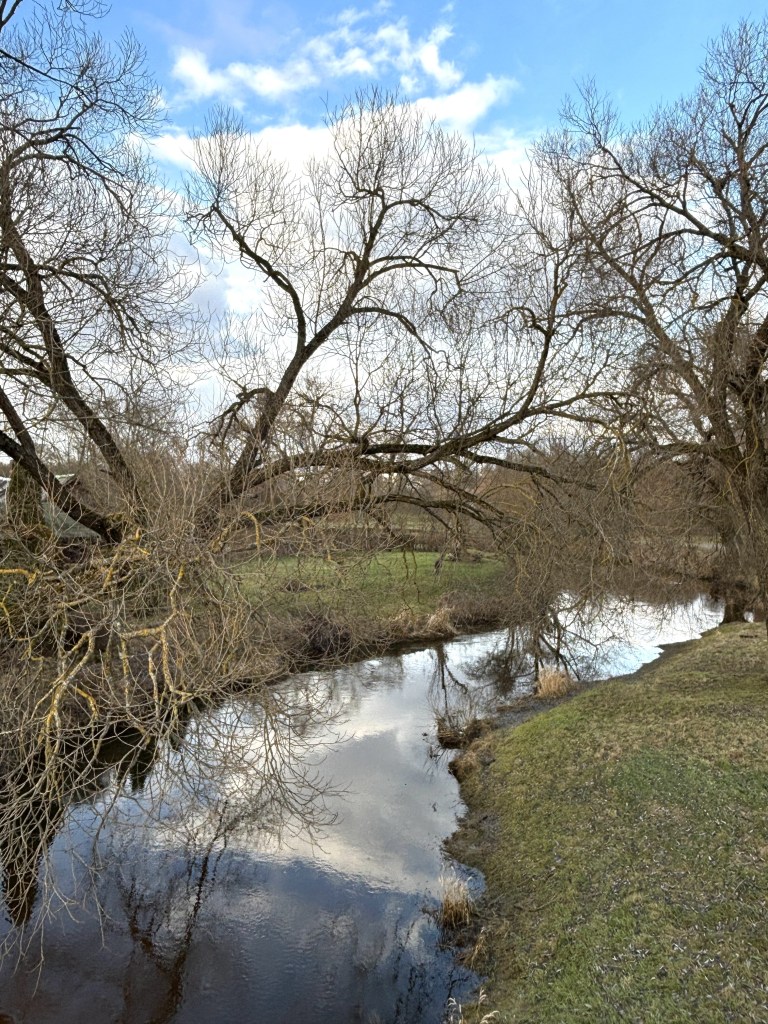
The Rēzekne River as it meanders through the downtown area of this small Latvian city of 26,000 people.
Well known cities like Seoul, Tokyo and London are immediately recognizable and bring iconic images to mind: man-made canyons of gleaming buildings, long steel bridges, and streets almost comically teeming with people. Then there are the places in-between, the oft-ignored stops along train lines, the towns with awkwardly paved streets, where the smell of homes still heating with wood or coal fills the air. Locals are apt to still speak an old dialect from centuries past, and to move with a patient gait knowing that whatever is around the next corner will inevitably wait.
Rezekne in Latvia’s eastern-most Latgale Region, built on 7-small hills, is such a place. An old city, lying only 39-miles from the Russian border, it was once part of the Pale of Settlement, the large area in western Russia where Jews were once permitted to live and prosper in relative peace. In the late 19th century the city was 60% Jewish, and as late as 1935, the population was a quarter Jewish.
On a recent overcast Friday, I took the bus from Daugavpils, where I teach English, and about 2-hours later arrived in Rezekne with a plan to meet Elina, the city’s Tourism Information Specialist. Speaking fluent English and well-versed in history, Elina met me outside the Green Synagogue located on Israel Street in the city’s Old Town. The Synagogue, she tells me, and the surrounding neighborhood, were miraculously spared from the intense bombing inflicted by the Russians during World War II. In fact, nearly 70% of the buildings in Rezekne were destroyed.
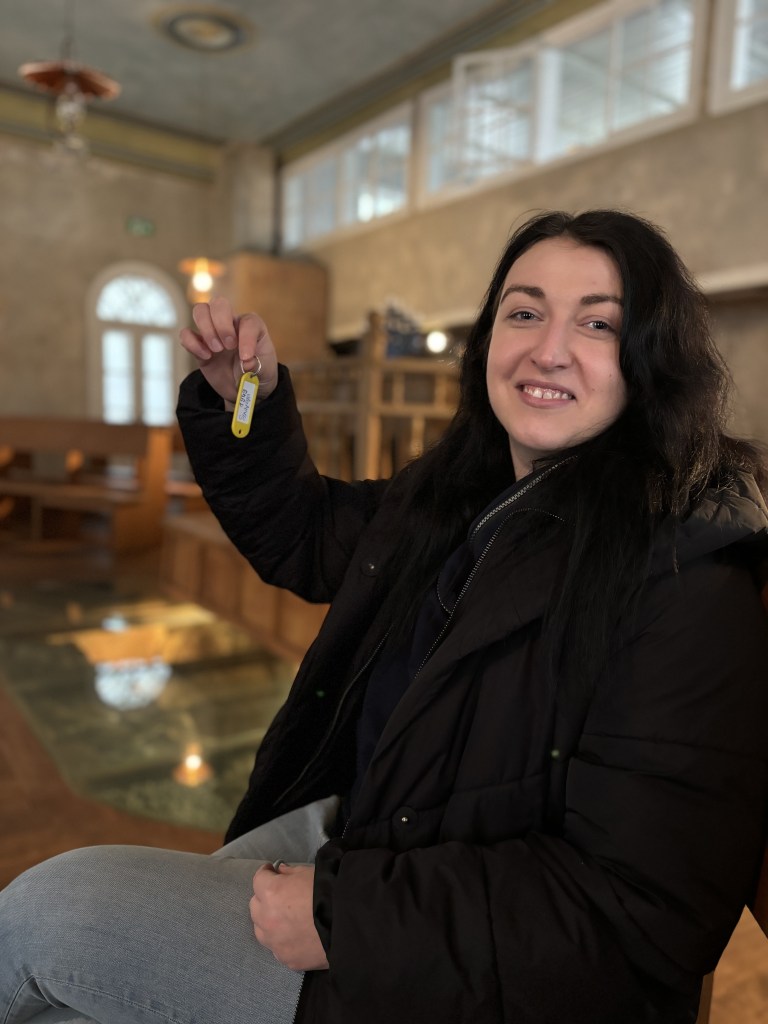
Elina, here holding the keys to the Green Synagogue, works in the city’s Tourism Department, and in my mind, is the best ambassador a city could have.
Elina, holds the keys to the synagogue, and so too, the historic details of the city, which she unfolds like the pages of a novel. After carefully leading me through the several rooms in the synagogue, which dates from 1846, she escorts me past the nearby buildings. She points to the former Jewish Bank, a modest but handsome brick building across the street. A minute later she directs my attention to an old fire house, once staffed with Jewish firemen who, she says, famously doubled as town musicians.
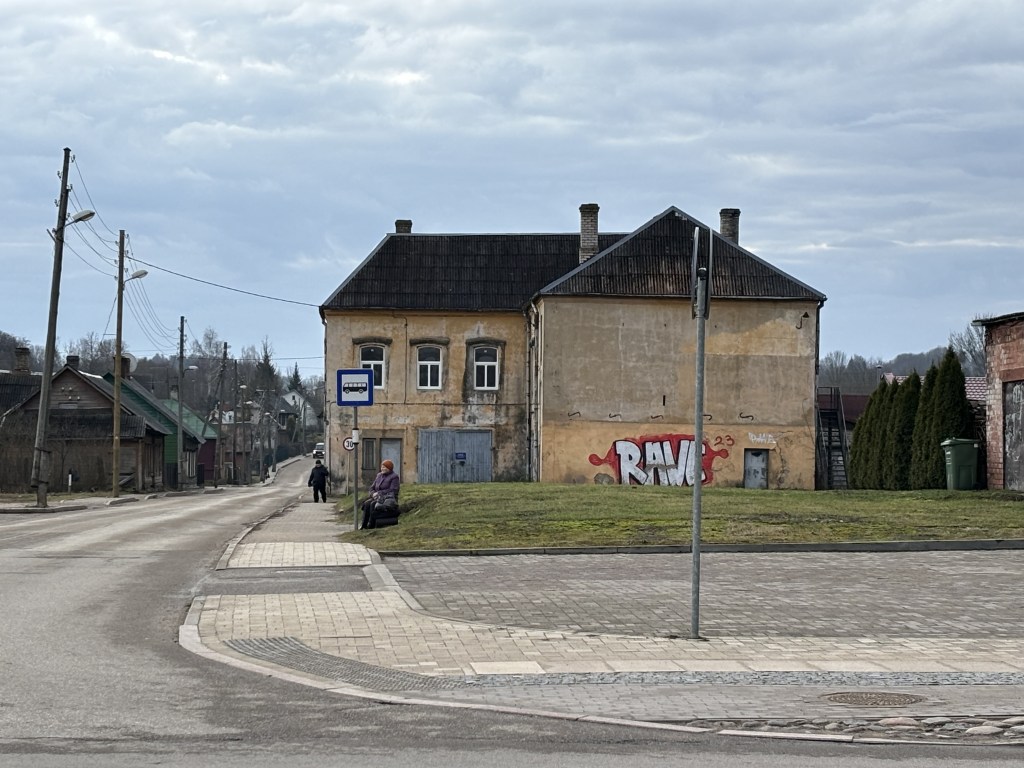
The former Jewish Bank, now a several unit apartment building.The old fire station, once staffed by Jewish fire fighters who doubled as the municipal band.
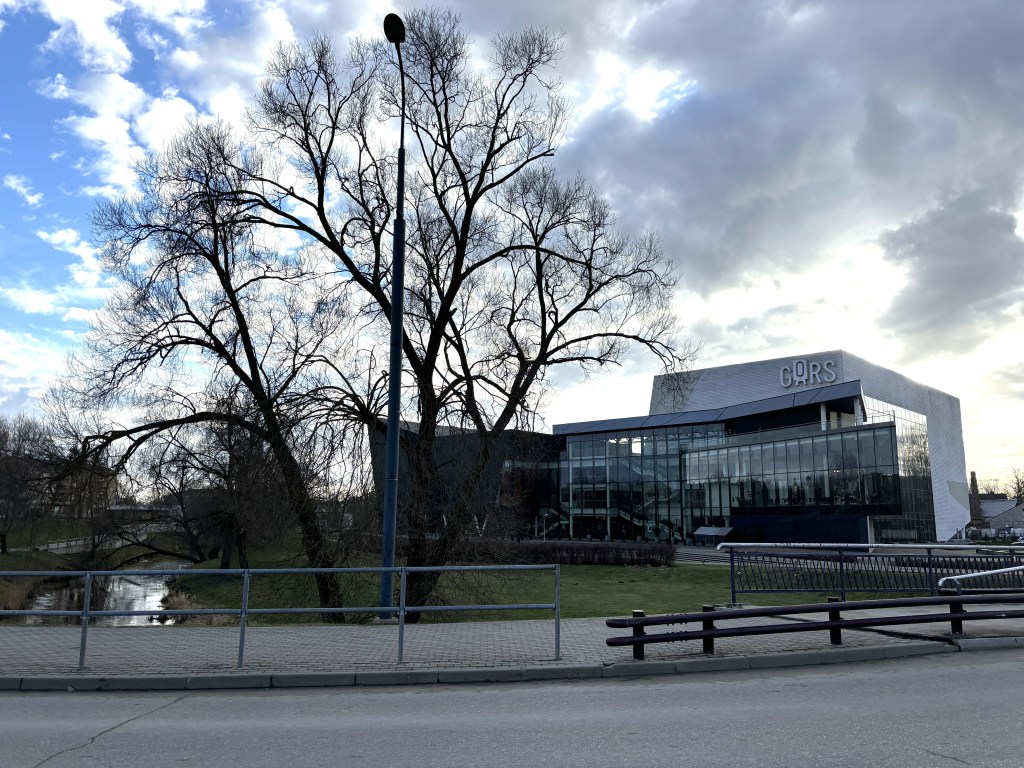
Having previously seen the city’s new Center of Culture, GORS, well-regarded across Latvia, I know the city is being proactive about trying to make itself a sustainable city. Smaller cities such as Daugavpils and Rezekne, like similarly-sized cities throughout the world, are confronting shrinking and aging populations. Their younger citizens are heading to the big more dynamic cities like the capital, Riga, here in Latvia. Just a few years ago, to invest in its heritage and to attract more tourists, the city hired a Norwegian team to come and restore the Green Synagogue which had remained in disrepair and unused, except for a few homeless souls, for some time. It’s that pride in itself and its history that left me rather impressed.
The new and nationally recognized GORS Cultural Center in Rezekne.
Unlike other places I’ve visited in Europe, the locals here did not take up arms to rid the city of its Jewish population. Elina vividly described to me the proud relationship between the Catholic and Jewish communities that once existed here. At the top of the hill, she says, is the double-spired Cathedral of the Holy Jesus Heart. The Jews would honor their Sabbath on Saturday and the town would be quiet. But on Sunday, as the worshippers left church, they would walk down the hill past blocks of Jewish-owned stores selling everything imaginable. There was a special energy in the air as sellers and buyers filled the main street with an excitement that symbolized the best the community had to offer.
It’s places like Rezekne, the towns and cities in-between, that quietly insist we slow down and listen to their history. In many ways, it’s likely they hold the most important lessons for our future.
Wall art depicting the oldest known photo of the Jews of Rezekne.
One of the things I have always loved about our home state of Maine is that it still is a place where a handshake binds a deal. When we closed on our home in 1985, no lawyers were present-just the four of us, the owners, Mr. and Mrs. Craigin, Marsha and me, and a bank employee. We shook hands in agreement, and the deal was as good as gold.
During a recent meeting with my “person of contact,” that is, my wonderful Latvian supervisor here at the university where I am teaching, I mentioned that nearly all the Latvians I’ve encountered during my first 5-months here, students, colleagues, nearly everyone, seem especially “earnest” to me. Ilze smiled as she heard my comment, and said proudly, in fact, that characteristic is a fundamental cultural feature here in Latvia and it’s called “Virs un Vards,” literally “a man and his word.” When a Latvian says they will do something, count on it. She said it was one of the most meaningful and descriptive expressions in Latvian culture.
Later, Ilze sent me this photo, the cover and name of an old children’s book here in Latvia, “Virs un Vards,” “A Man and His Word.”
“I feel that it is healthier to look out at the world through a window than through a mirror. Otherwise, all you see is yourself and whatever is behind you.” Bill Withers
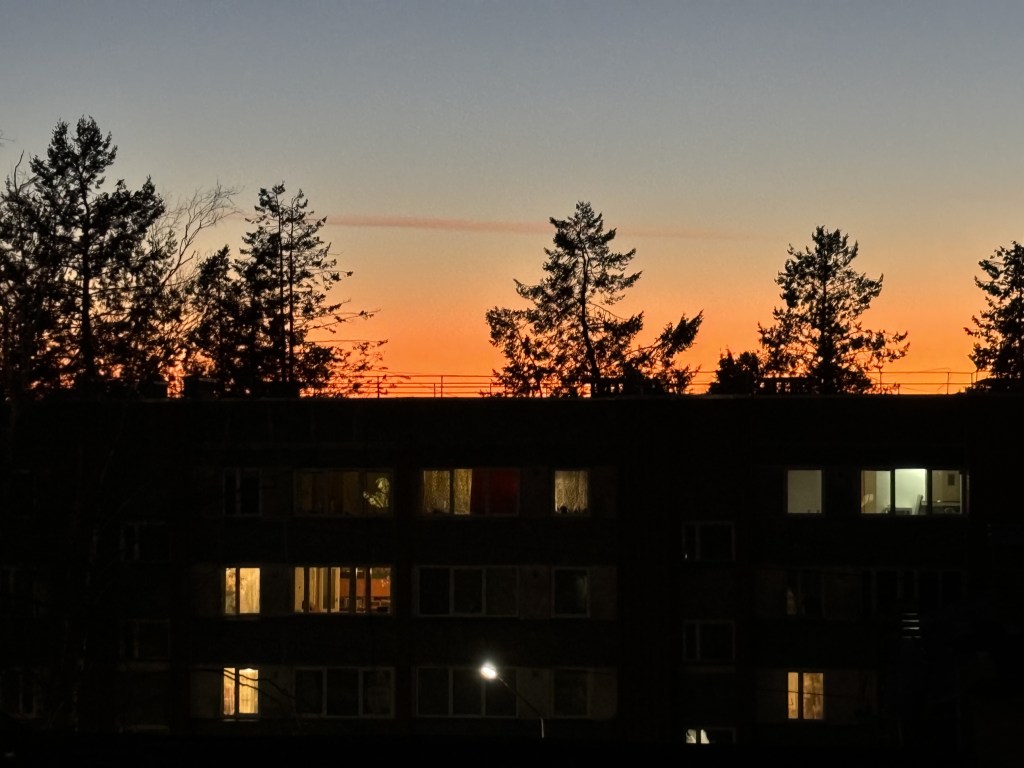
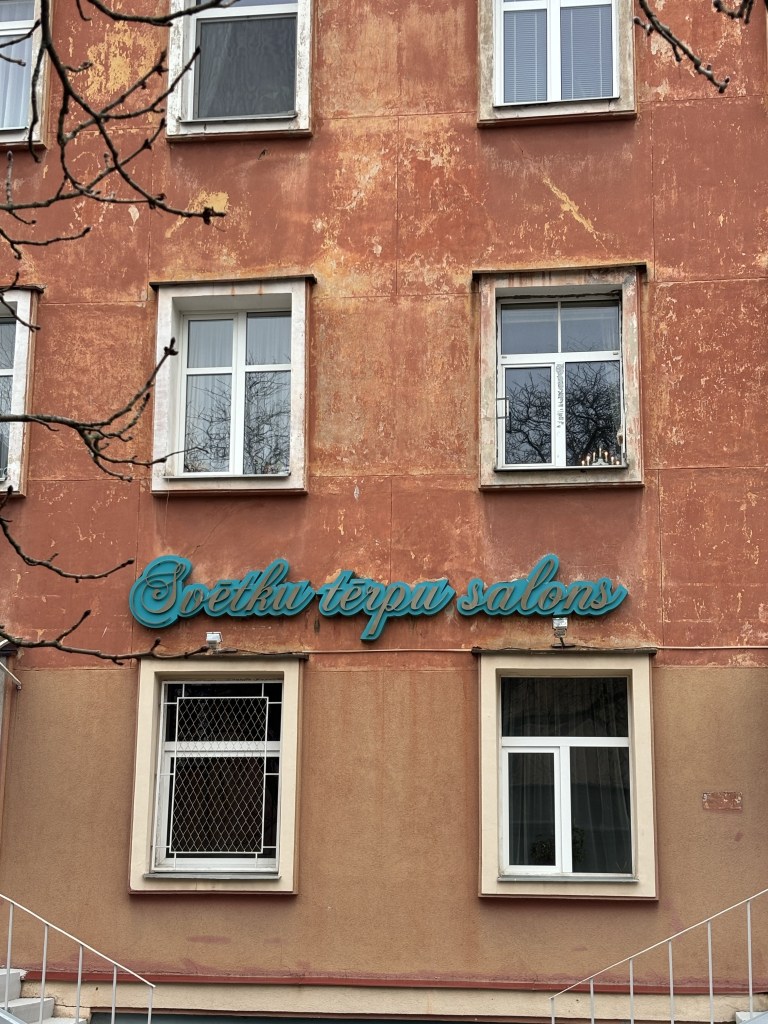
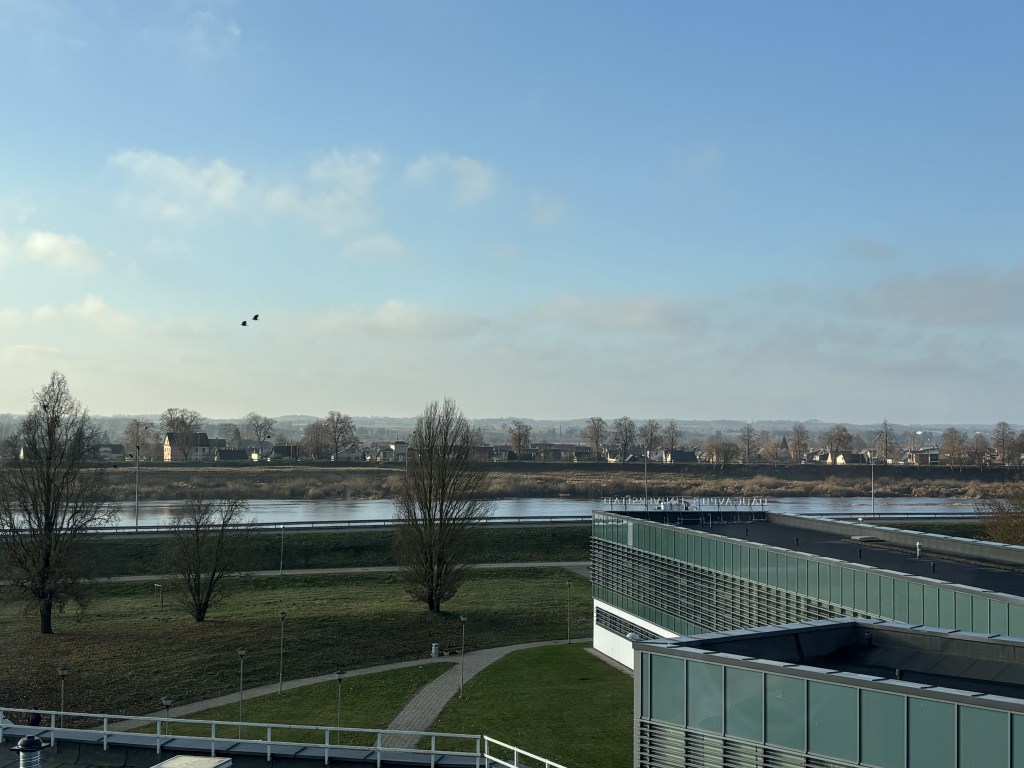
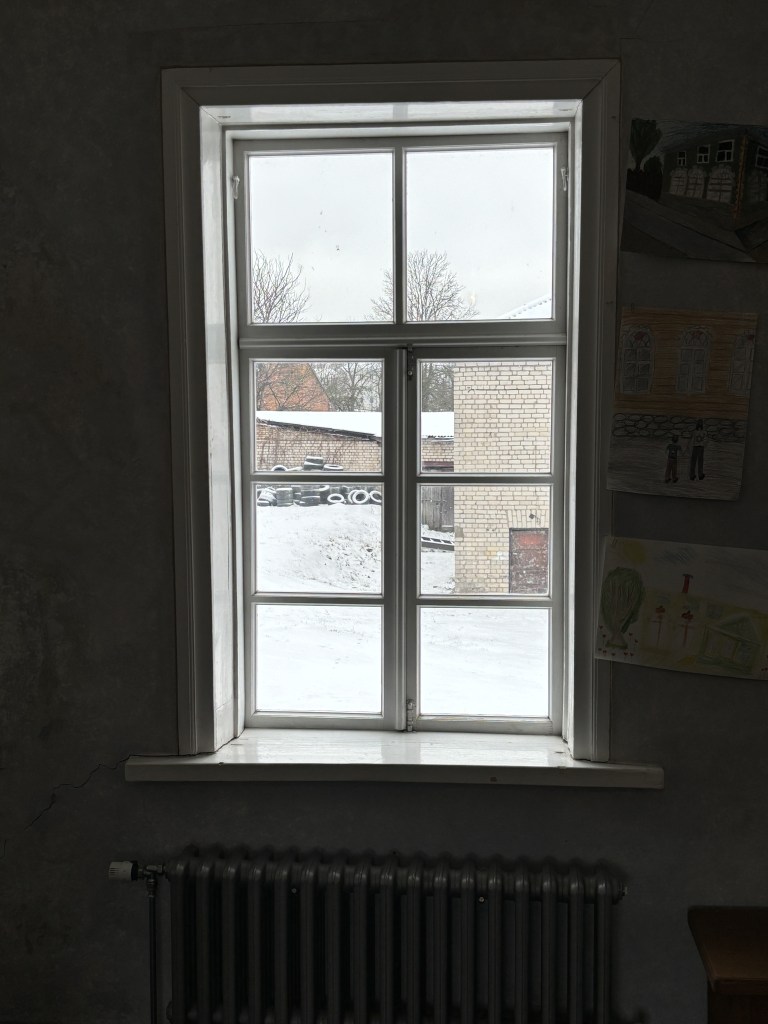
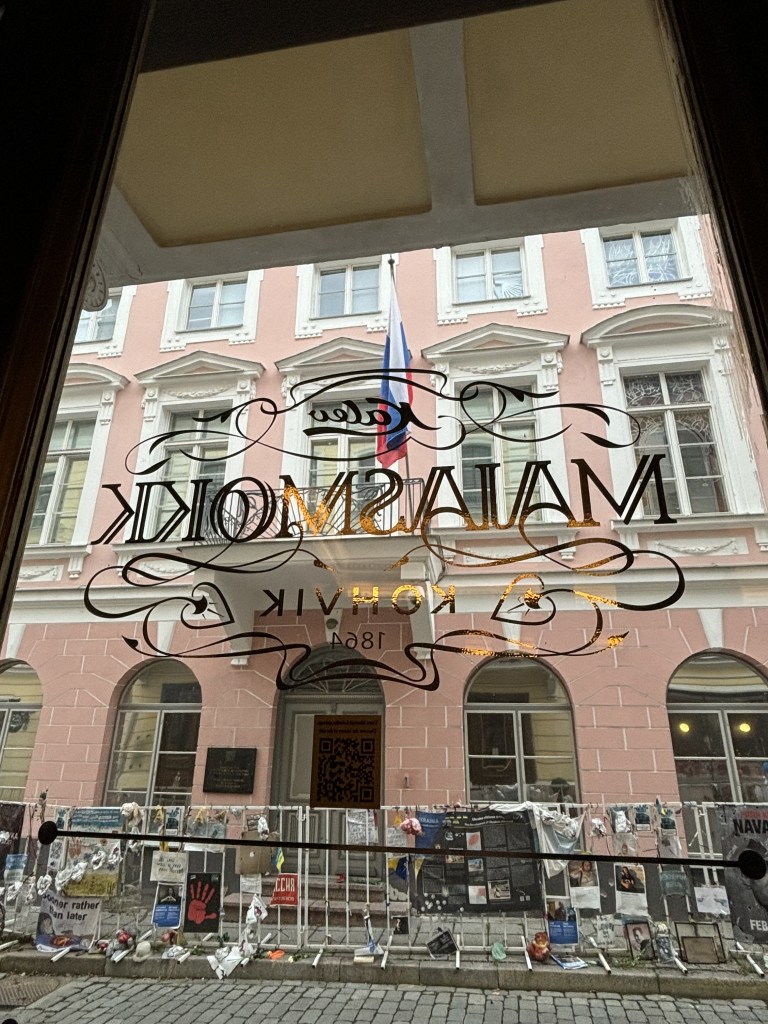
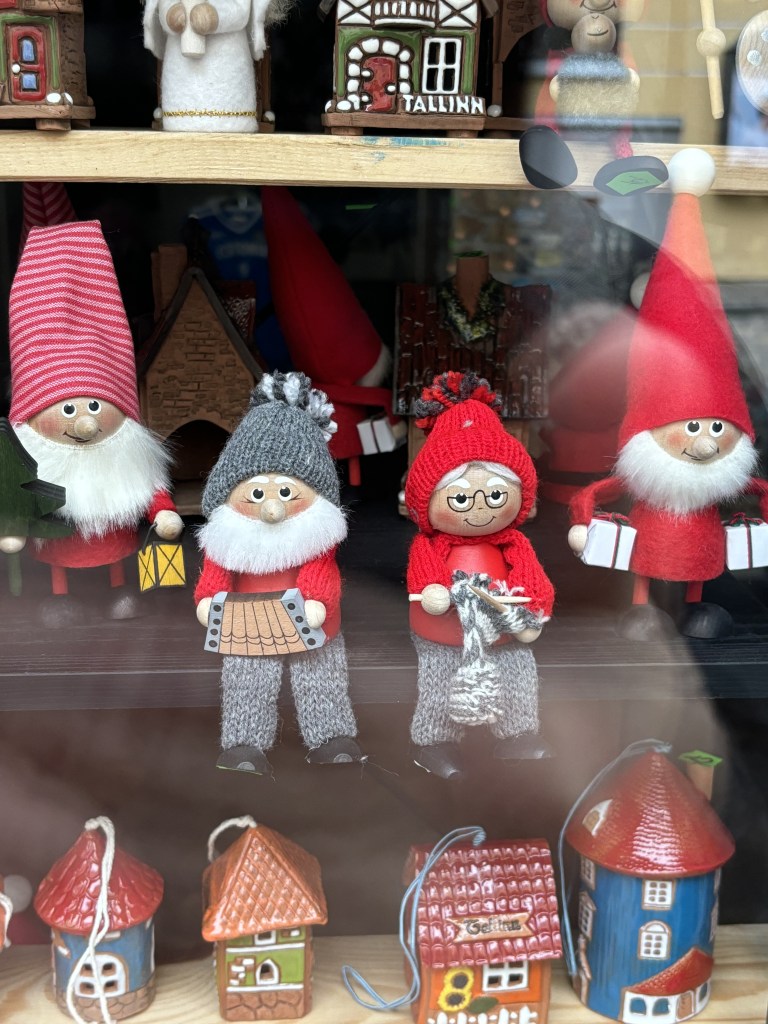
The windows of local residential flats as seen from a hallway near one of my classrooms (Daugavpils, Latvia)Side windows of a Stalin-era building along. November Street, one of our major thoroughfares here in Daugavpils, LatviaLooking north and west toward the Daugava River from my office in “The New Building,” at Daugavpils University. I hold lunchtime conversation classes here. (Daugavpils, Latvia)Looking out from a synagogue window. At the Green Synagogue (1845), one of the oldest wooden structures in the city of Rezekne, population 27,000. (Latvia)From the window of Tallinn’s oldest coffee shop, Cafe Maiasmokk (circa 1864). That’s the Russian Embassy across the street–note the protest paraphernalia. (Tallinn, Estonia)
Christmas window of shop in the Old Town. (Tallinn, Estonia)
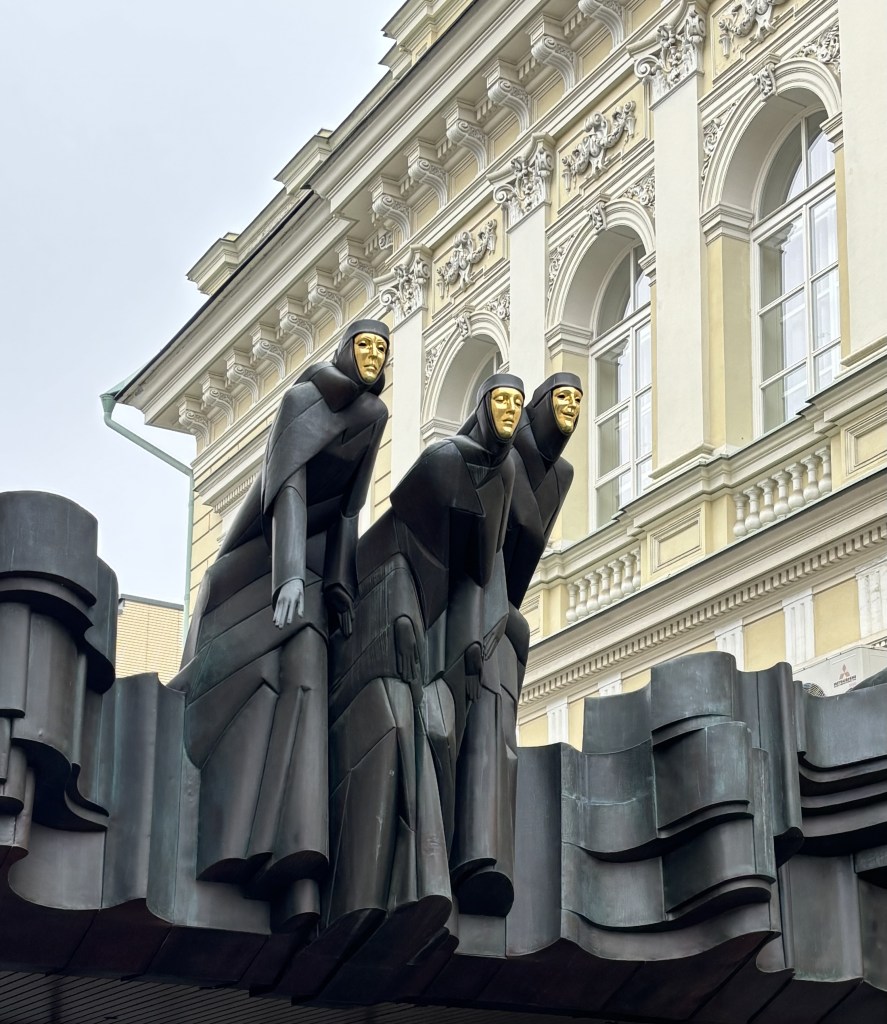
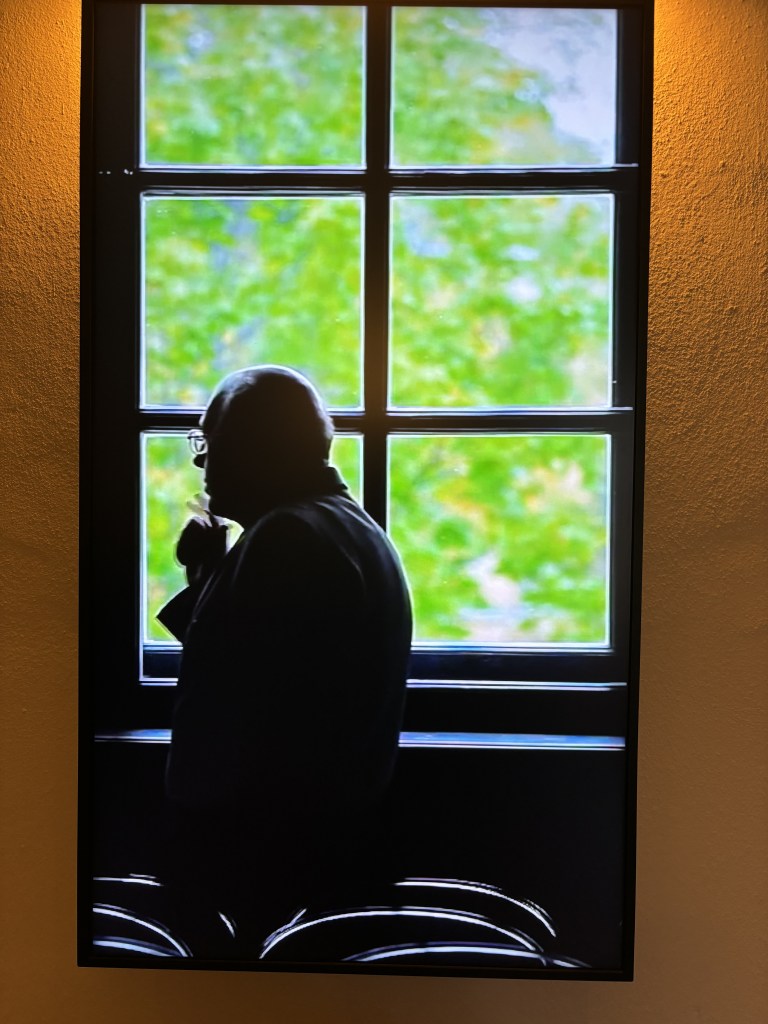
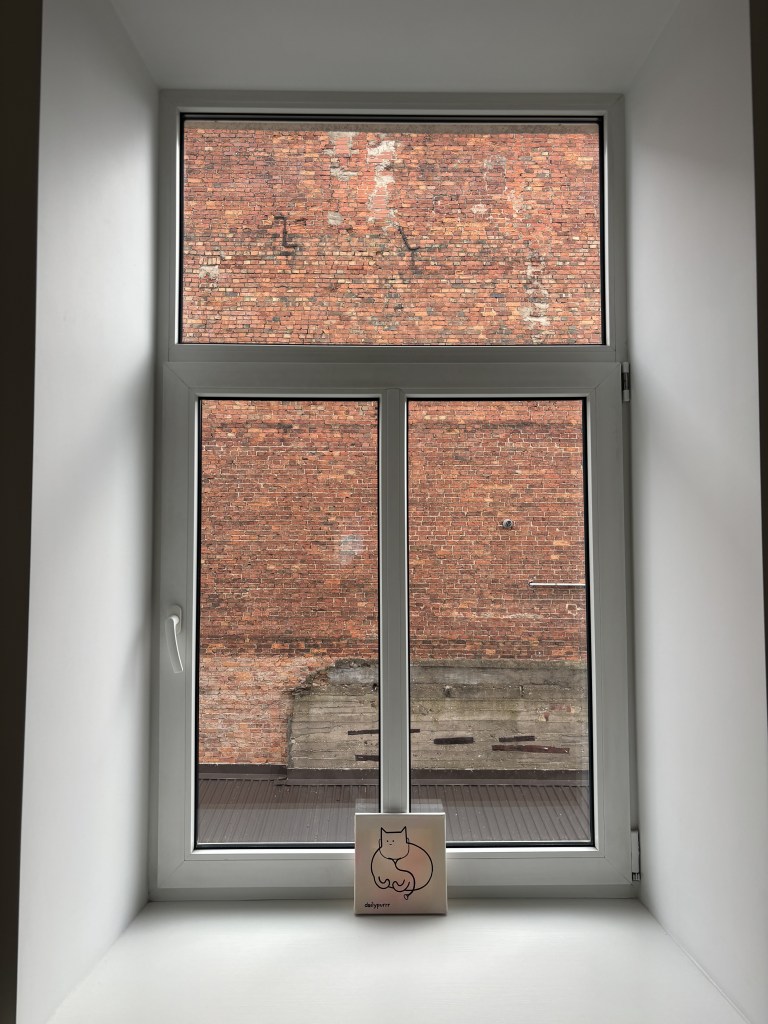
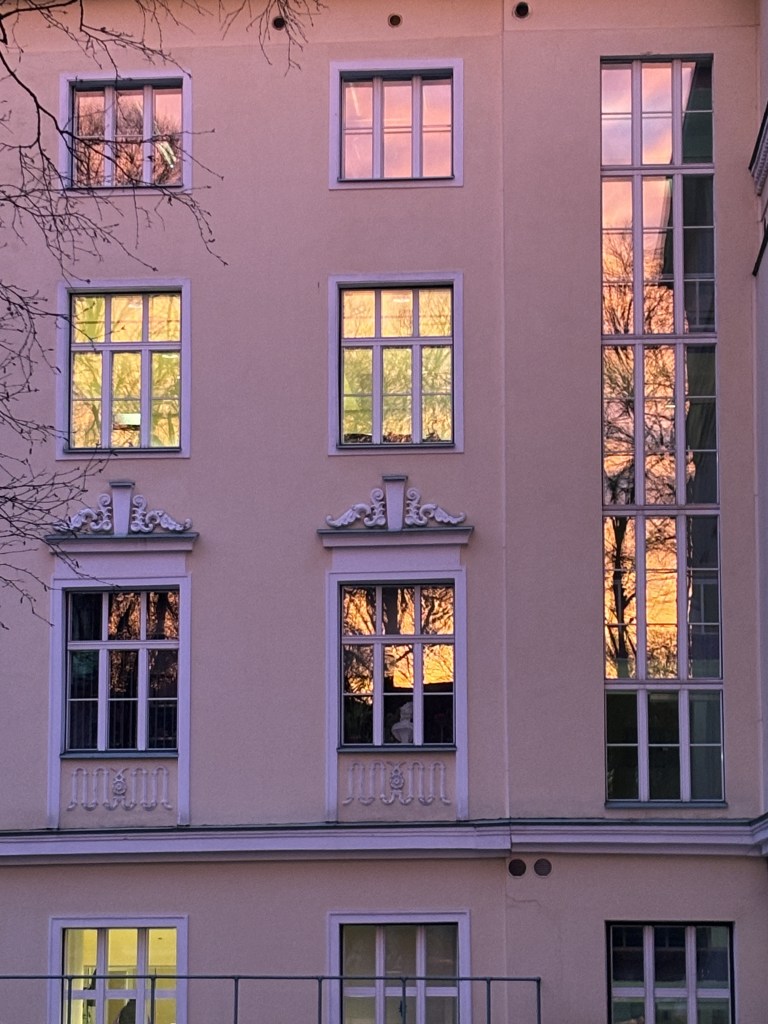
Windows overlooking nuns. Location of the Vilnius Theater. (Vilnius, Lithuania)Artist Mark Rothko, born in Daugavpils, Latvia, stands near a window, shortly before his death. There is a marvelous art museum in his name here in Daugavpils.View from the window of a recently renovated flat in Daugavpils, LatviaWindows reflecting a brilliant Tallinn sunset. (Tallinn, Estonia)
“Humility is the light of understanding.” John Bunyan
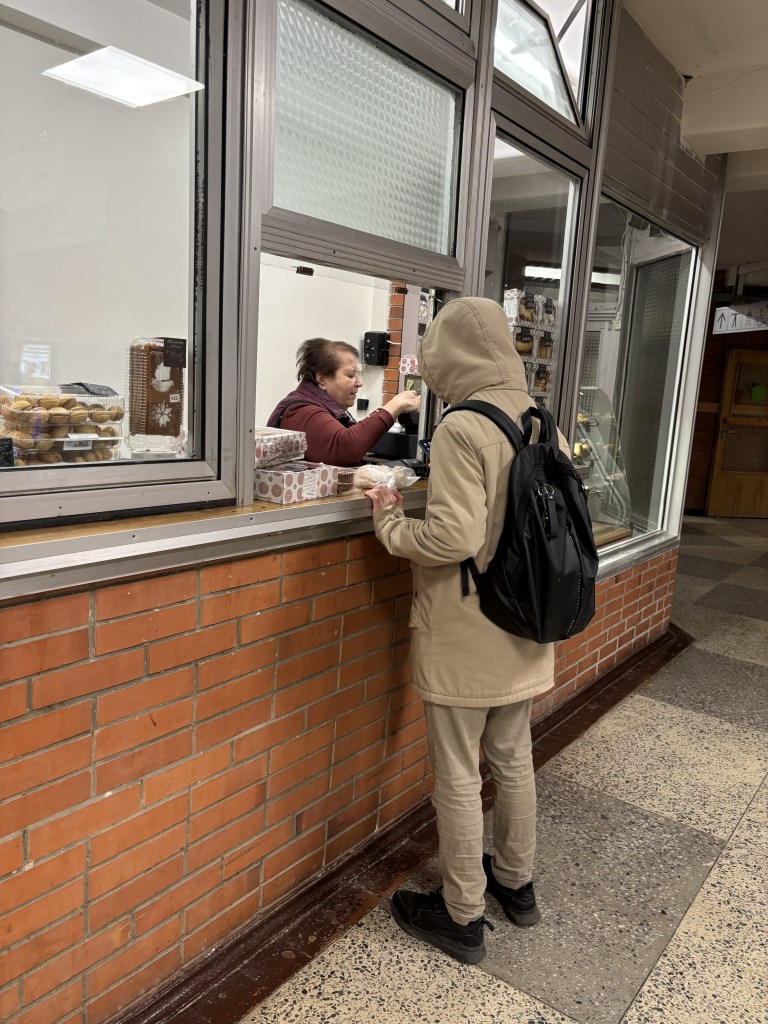
It’s a quiet dance. She listens to my request, dutifully leaves the window to make my coffee and to heat my Latvian snack in the microwave. I hear the timer ring in the distance and she returns to calculate my bill. I seek to embellish our brief time together as passengers on this twice-weekly routine, by asking how her day is going.
Brick by brick, exchange by exchange, I am building a social cottage here. A few people, like Lydia, help piece it all together. Her slight smile, her friendly voice, are the mortar that help hold it all together. I know I could easily leave it like that: comfortably anonymous and perfunctorily routine. But then, I’ll miss learning something more, about Latvia, about this place, about Lydia.
So I ask if I can speak to her sometime in the days ahead-an interview of sorts, I say. She agrees, and I wonder if she understands my request.
Lydia was born 62 years ago in the tiny hamlet of Faltopi about 30 kilometers southeast of Daugavpils. It is near the Latvian-Belarus border. She was an only child, she tells me, as was her husband of 42-years and their daughter, Inesa.
Inesa, though, changed all that, having 5-children. She moved to the UK, leaving the country, as a number of younger Latvians do, seeking opportunities and higher paying jobs elsewhere. When I learn that Inesa’s eldest daughter, Ustina, is in dental school, I say with some certainty, “Oh, you must be very proud.” A huge smile envelops Lydia’s face.
Lydia serving a student at the campus canteen where she works weekdays from 8:30 – 4:00.
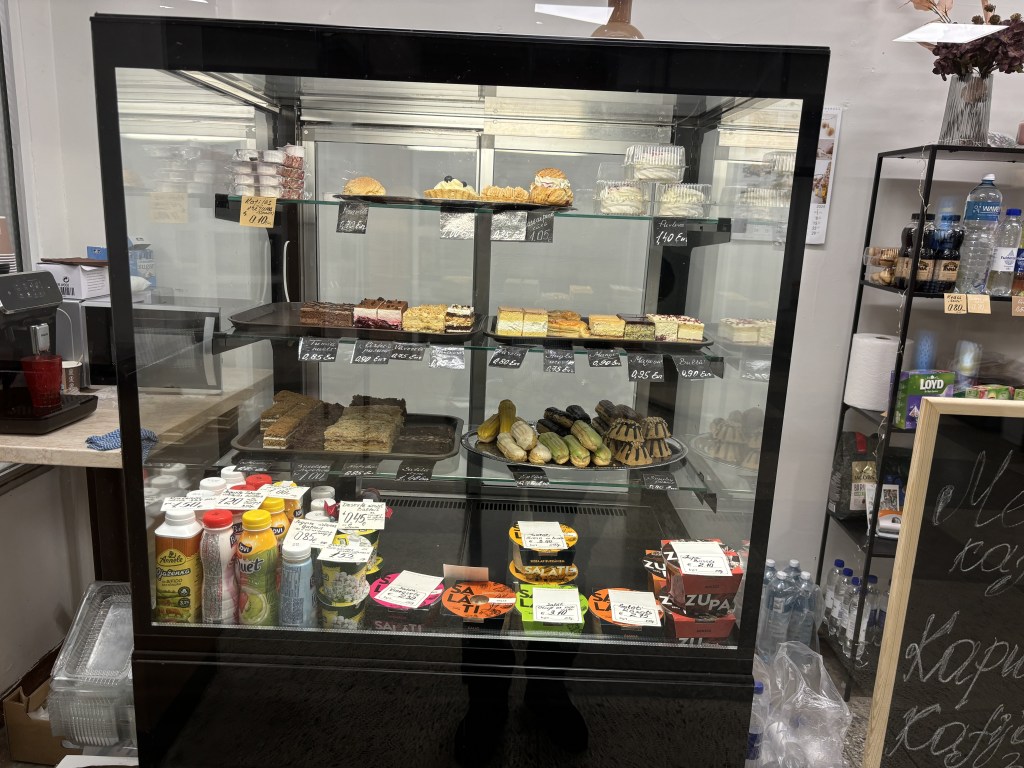
With her grandchildren living in England, Lydia likes to practice using her English-luckily for me. Latvians are highly literate (99%+) and well-educated. Lydia graduated from Riga Polytechnic University, majoring in building and architecture. It’s her interest, she says, in meeting and speaking with others, that brings her to this canteen window, a portal for brief exchanges of food, beverage and conversation.
This semester I visit Lydia’s building on Mondays and Wednesdays where I lead lunchtime English conversation classes. Knowing she’s here, that I can say hello, ask how she’s doing, adds something intangibly meaningful to my day. And Lydia, was my mom’s name.
Lydia and I share a history now, a place in time and space. She is not part of the official curriculum I offer my English students, and won’t be mentioned in a written report to the US. Embassy, or to program contacts in Washington, D.C. But meeting Lydia is exactly why I am here, teaching in Latvia.
Does every question have an answer? “What is the boiling point of water?” Of course, the accepted answer is 212F/100C.
The Green Synagogue in Rezekne, Latvia
Why am I drawn almost magnetically to old synagogues in nearly every city I visit?
Since our recent journey to the Green Synagogue in remote Rezekne, Latvia, I have been pondering this question.
Well, as a Jew, feeling a need to visit synagogues would be a reasonable explanation. I am familiar with almost all the artifacts and rituals associated with a synagogue. Very little about them is “foreign” to me. Seeing a matzo oven on the ground floor of the Green Synagogue, while a pleasant surprise, is a familiar tradition. And yet, as I walked the Camino de Santiago the well-known pilgrimage across northern Spain, even being Jewish, I was often drawn to churches we passed along the way.
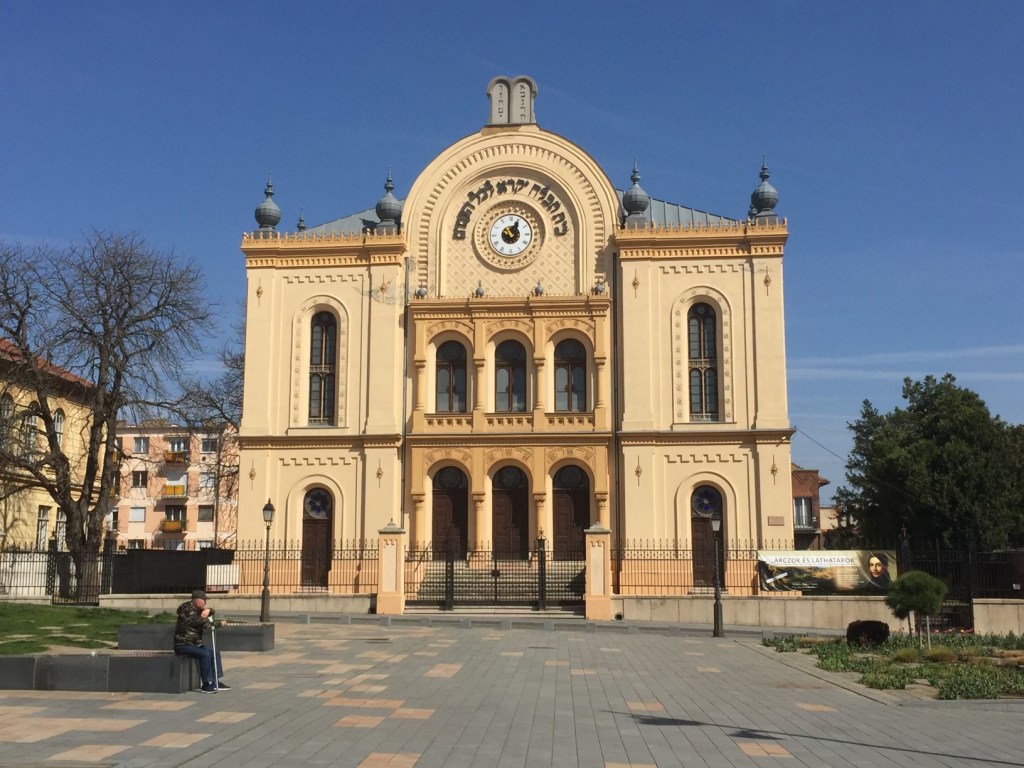
The Synagogue of Pecs, Hungary, consecrated in 1869.
Perhaps being a history buff makes as much sense as any explanation. I majored in history in college and remain fascinated with the connections old buildings, like synagogues, have with the country, cities, and cultures I find them in. The old synagogue in Pecs, Hungary, is part of that country’s dark history of suffocating the Hungarian Jews out of existence in a relatively short time during World War II. But it’s much more complex than solely the historical connections.
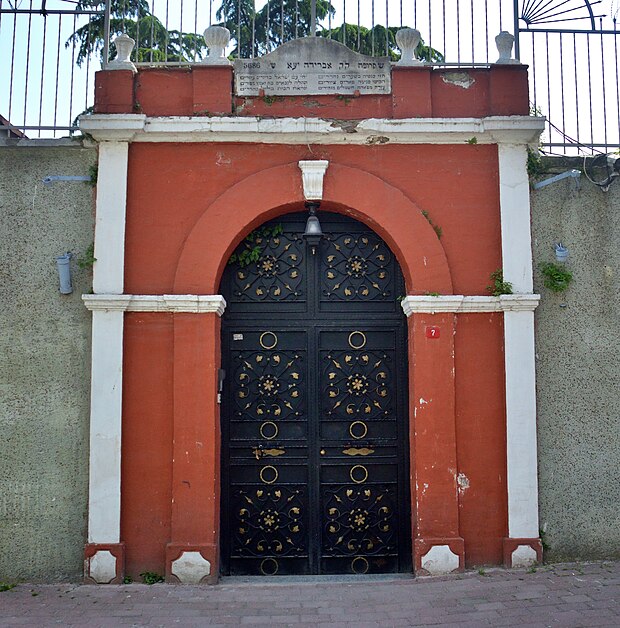
No, being a curious traveler is a much more reasonable explanation. Some of these old buildings have become world famous tourist destinations. The Ahrida Synagogue in the Fatih neighborhood in Istanbul, for example, was a stop on our tour in that Turkish city. It was built in 1430 as part of a then thriving Jewish community. My curiosity as a traveler was stopped in its tracks as I stood humbly in front of its ancient gate.
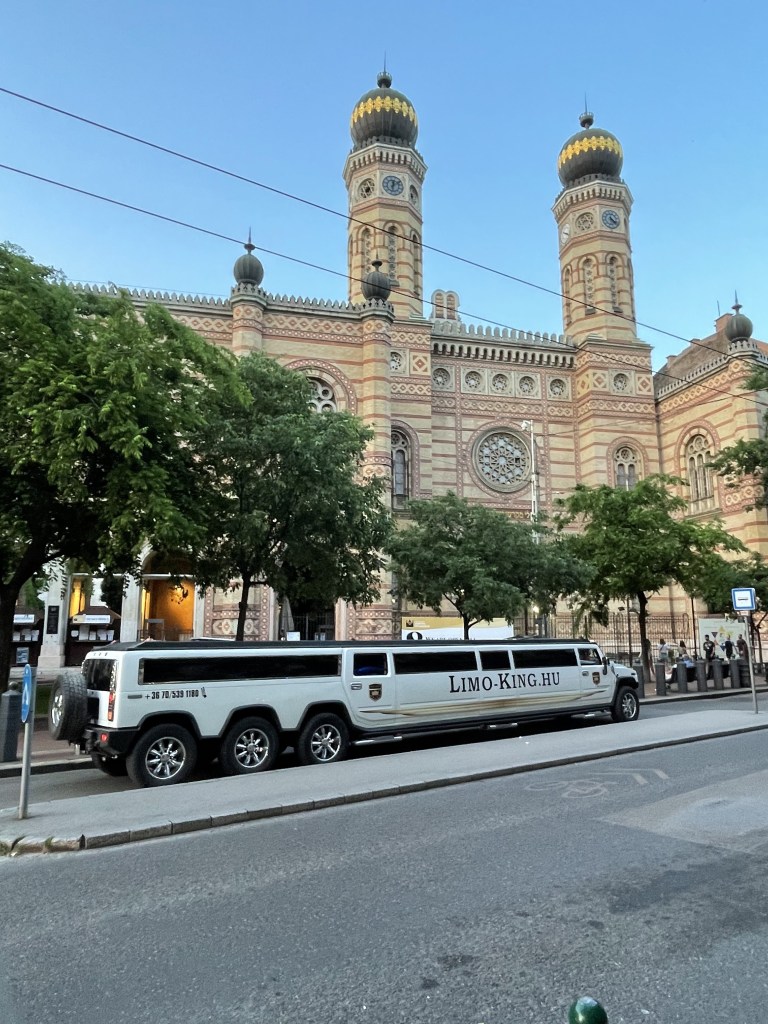
The Ahrida Synagogue (circa 1430) in the Fatih neighborhood of Istanbul.The Dohany Synagogue (1854) in Budapest is, understandably, on nearly every tourist’s itinerary
A traveler to Budapest can’t escape the overwhelming presence of the Dohany Synagogue in that amazing city so richly endowed with countless tourist destinations. It’s the world’s second-largest synagogue with an impressive seating capacity exceeding 3,000 people. Few travelers to Budapest miss stopping there.
I am drawn to synagogues for all these reasons and likely many more. But what I do know, is that I rarely connect to a place more intimately than I do through its synagogue. I feel part of their history–an intimate connection that often leaves me saddened when I depart.
Sad for what these old synagogues represent: once-vibrant communities that bloomed across most of Europe, now evaporated. Jewish people energized Budapest to the tune of 24% of its pre-World War II population. Vilnius, the capital of Lithuania, then nicknamed the “Jerusalem of the East,” once had 106 synagogues. Today, it has one. Cities and towns here in eastern Latvia had populations that were 50-60% Jewish. In the Rezekne of 1935, home of the Green Synagogue pictured above, 75% of all commercial businesses were owned by Jews.
So, why am I drawn to synagogues? Questions rarely have one simple answer. What is the boiling point of water? As we know, the boiling point of water is 100˚C and 212˚F, but alas, that’s only at sea level. Even for that one, there’s more than one answer…at different altitudes or pressures, the number is different. Answers to questions are always much more complicated than that.












 Short Talks Through a Wide World