Definition: Everyday carry…a collection of useful items that are consistently carried on a person every day.
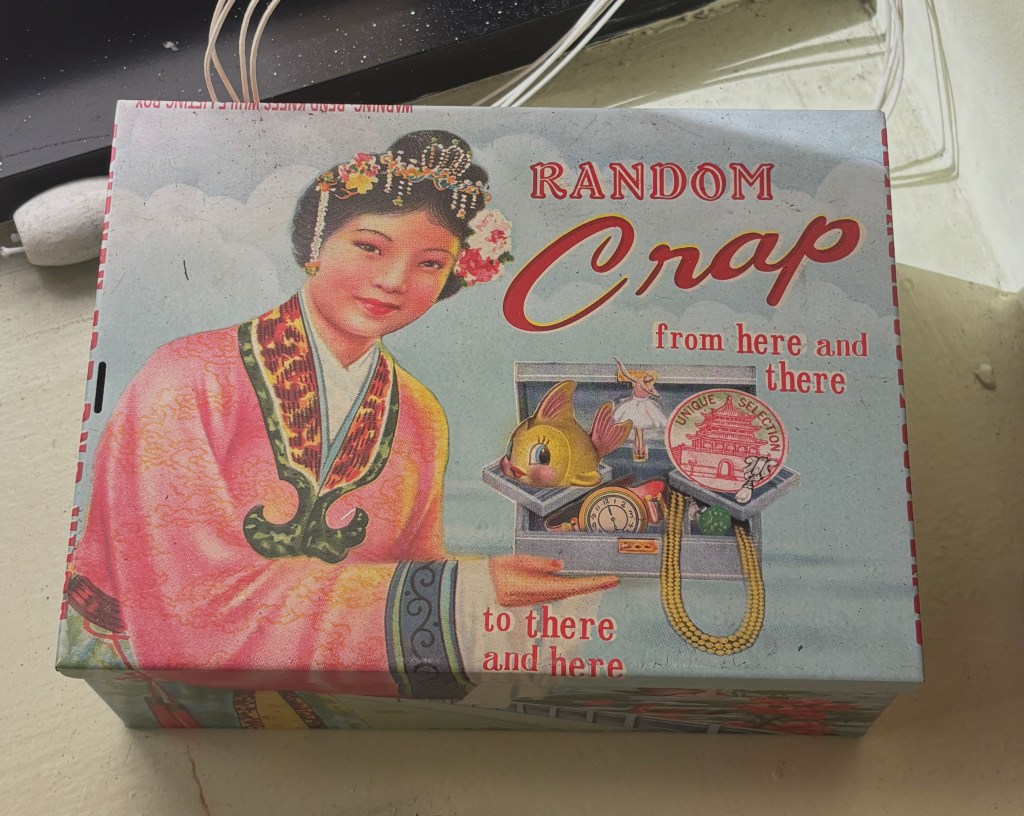
No, not random crap. But rather, everyday carries.
Is it a statement of preparedness, nostalgia, practicality, or yet another kind of subculture? In a brave new world of intense connectivity, where many people understandably seek privacy and anonymity, I thought this concept might offer a platform for gentle revelation.
I want to recognize our tendency to over-idealize things. Mitch Albom, from Tuesdays With Morrie fame, noted “We are too involved in materialistic things, and they don’t satisfy us. The loving relationships we have, the universe around us, we take these things for granted.”
In contrast, I’d like to allow for the occasion that treasured items might actually provide a carpet ride to another more revelatory place. Design as Art author Bruno Munari said, “When the objects we use every day and the surroundings we live in have become in themselves a work of art, then we shall be able to say that we have achieved a balanced life.”
I used to regularly carry a funny looking titanium utensil called a spork that attached to a carabiner. At varying times it functioned as a screwdriver, a fork, a spoon, and even as a wrench. It became a favorite carry of mine. Is that really different, other in magnitude, from the bloke who preens over his Bentley SUV?
A spork, an old everyday carry of mine
If a face can launch a thousand ships, then a favorite item can spark a revealing conversation. Then there’s the My Essentials Series, 10-Things I Can’t Live Without. Comedian Jerry Seinfeld, for example, shares why yellow legal pads and Bic pens are important tools in his life. I love that simple items can be a platform for self-disclosure and revelation–the magical interlude when someone brings enthusiastic candor and transparency to the moment. In effect saying, “I’d like to tell you a little bit about who I am as a person.”
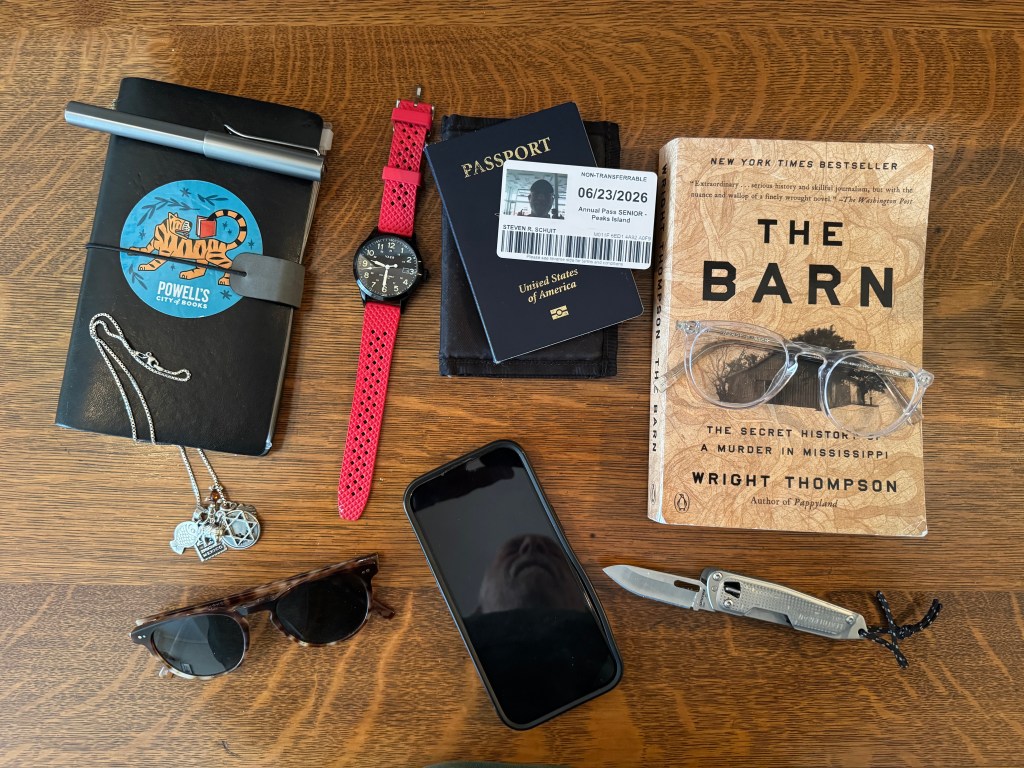
My current everyday carry…
My everyday carry includes from top left…A notebook and roller ball pen for fun writing when on the run, my favorite old-school analog watch from a California company, Vaer, my wallet with key documents including my passport and Peaks Island annual ferry pass, a good read I can tuck into my backpack–in this instance, The Barn, a non-fiction work about the 1955 murder of Emmett Till in Mississippi, glasses from Warby Parker, a pocket knife with practical blades and tools, my iPhone, Warby Parker shades and finally, my necklace with silver charms from different countries I have visited.
This batch of everyday carry reflects, I think, my love of traveling, of staying off the couch, of leaning in toward old-school, of valuing simplicity.
Now it’s your turn. What does your everyday carry say about you? I’d like to know.
“I found the method both creative and deeply meaningful, and it offered a refreshing perspective on how emotional values can be integrated into language teaching.” -Latvian English Teacher
“…unlike any traditional language teaching activity I had encountered before. Based on a conceptual art project, the session introduced the idea of using personal items that hold emotional value as a basis for classroom interaction. Students bring in meaningful objects, write emotional statements about them, and participate in an ‘auction’ by bidding with their own reflections. I found this approach fascinating as it blends reading, writing, speaking, and listening skills in a highly personal and emotionally engaging way. It encourages students to be vulnerable, empathetic, and expressive—qualities that are often underdeveloped in language classrooms.” -English Teacher in training from Turkey
“I was really inspired by your Emotional Values Auction idea…It was absolutely awesome! You were able to make me think about those aspects that have remained in the shadows to this day.” -Estonian English Teacher
“The Emotional Values Auction” was not just about giving away objects but it was about sharing pieces of the heart. That made it truly unforgettable. It showed me that emotional value can often outweigh material worth, and that the act of giving can be even more meaningful when it’s based on understanding and empathy.” – Undergraduate Education student from Turkey
Introduction
An Emotional Values Auction (EVA) is a new, unique, and innovative methodology for teaching English. Based on a conceptual art process originally conceived of by Portland, Maine (USA), artist Adriane Herman, it replicates the structure of an actual auction. The process incorporates student skill development in the areas of writing, listening, reading, speaking and presenting. The context is both cognitive and emotional, as the students consider items to submit to an in-class auction that represent their experience with, for example, the emotions of generosity, pride, happiness, or loss. Students present their items to the class and expand on their experiences by telling their stories. Other students “bid” on the items that they feel a connection to. “Bids” are made by writing about why they think they would be good stewards for receiving the items “up for auction.” The submitted “bids” are reviewed by the original student donating their item, and that person selects the final recipient. No money is exchanged. The “currency” is shared experience and learning. Students report positive levels of satisfaction with the process based on several factors.
From a Unique Art Concept to an ESL Teaching Methodology
During the summer of 2023 while a friend was visiting from out of town, he suggested we take-in an art show in Portland, Maine. We expected a typical art show, but instead, found we had entered an art experience called an “Emotional Value Auction.” In consisted of displayed items that people were “letting go of” that had emotional value to them. The items were accompanied by written statements from the owners about what the item meant to them, and why they felt it was time to “let it go.” It was fascinatingly eclectic, that is, it included items as varied as a grandmother’s old flannel shirt, an antique leather diary, even an unused B-B Gun rifle from the early 1980’s.
Displaying “generosity,” an English student enters her artwork into the auction.
Because it was an auction, you could “bid” on any item if you were somehow desirous of it. A visitor to this so-called Emotional Value Auction, could submit a “bid” on any item, or multiple items, by writing a statement about why they felt connected to it. The “bids” were collected during the several weeks the auction was underway and eventually they were given to the respective person who had originally submitted the item to the auction. That person would subsequently review all the “bids” placed on their item and select the one that “moved them,” or appealed to them, the most. The item was then awarded to that person.
Another English language student after her successful bid.
I thought that this process could effectively be adapted to an ESL teaching methodology, one that helped develop the skills of reading, writing, speaking, listening and even presenting. So, I designed an approach and piloted it last Fall in two of my English classes at Daugavpils University in Latvia. The results were amazing.
Follow-up evaluations indicated that students both valued and enjoyed the process more than other learning activities they had experienced while learning English. Furthermore, and to my surprise, students reported that the Emotional Values Auction process revealed aspects of classmates they had not known previously, for example, their interests, hobbies and skills. And as a result, many felt that the class had become a closer group of learners.
Since that semester, I have implemented the EMA is several additional Spring classes. The results have been similar, that is, students report enjoying the learning process, while at the same time, enhancing their English language skills, acquiring new related vocabulary, and reporting similar group development outcomes.
Recent Developments in the Baltic States English Teaching Community
A trio comprised of two U.S. State Department English Language Fellows (ELF’s), and a Specialist, developed a so-called “Road Show,” where we offered training for regional English educators hosted by area educational institutions. We dubbed these trainings, “mini-conferences,” as the participants were offered the opportunity to attend two-workshops on a Saturday or Friday morning. The Emotional Values Auction was one of these workshops, intended to introduce the methodology to teachers and to provide a Teacher’s Guide as follow-up to interested attendees. These workshops have been offered in Wroclaw in Poland, at the University of Tartu in Estonia, in Riga at the University of Latvia, and in Daugavpils. The reception to the methodology has been highly favorable as indicated by the representative comments quoted at the outset of this post.
Alfred Mercier, a noted early American playwright, novelist and philosopher, who spoke five-languages, said, “What we learn with pleasure we never forget.” The Emotional Values Auction process seeks to combine the cognitive aspects of language learning with a focus on emotions all while providing students with a fun and memorable learning experience.
If you are an educator, or have further interest in the Emotional Values Auction process, and would like a copy of the accompanying Teachers’ Guide, please contact Steven Schuit: Schuitstephen33@gmail.com
You do the Hokey Pokey and you turn yourself around
That’s what it’s all about
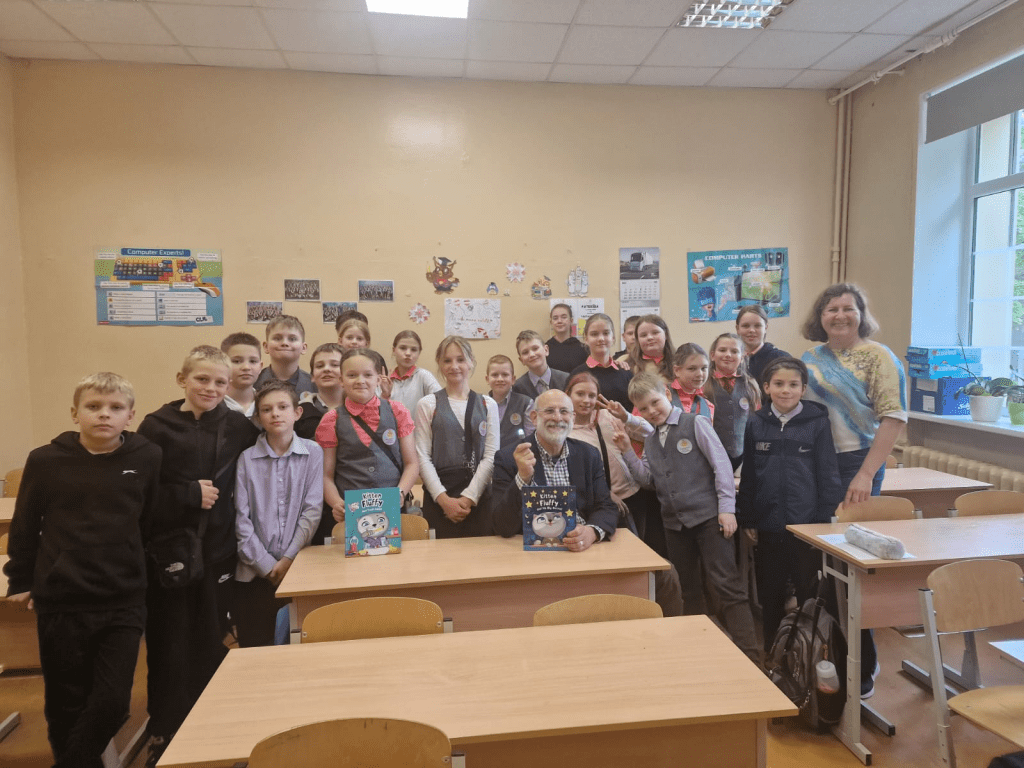
Alla, pictured right, teaches this 4th Grade class here in Latvia. She was a student of mine in a specially designed “Advanced English” class for local English teachers. She invited me to come to her class and read to her students.
English Language Fellows (ELF ) work worldwide for the U.S. State Dept. We are, lifting a marketing phrase used by the Peace Corps, doing “the toughest job we’ll ever love.” Figuratively, we’re “soft diplomats.” Nothing could be closer to the truth. Every time we step into a classroom we represent the United States, whether it’s explicit, like when the State Department logos are pasted onto the first slide of all our PowerPoint presentations. Or, on the other hand, as I lead an informal English discussion group during the lunch hour and we loosely discuss topics such as traveling abroad or the success of the Latvian film Flow winning an Academy Award for best animated film. We are inevitably seen as representatives of the U.S. and what we convey, even what may be inferred by the locals, carries weight.
We “do the Hokey Pokey” day-in and day-out, by teaching classes at our assigned university or giving presentations at the local American Information Centers, usually funded by the respective country’s U.S. Embassy. But we also get countless requests by English teachers in the local community to come to their classes to be, as they say in baseball, utility players. Depending on the age of the students, your role as a guest speaker might include giving a presentation on the U.S. Education System, or reading a story about Fuzzy The Cat who thinks there’s a monster under his bed.
Yesterday, I kept a commitment I had made weeks ago to one of my students, Alla, a 4th grade English teacher here in Latvia. While attending one of my classes, Advanced English, designed for English teachers like herself, she asked, somewhat haltingly, if I could come into her class and read to her students. I never say “no.” And as we got things going in her classroom, I thought I would break the ice, by asking the students if they had any questions for me–it’s a quick way too of assessing the English-speaking ability of the group. After asking me what my favorite countries were (I said, South Korea and Hungary, after the U.S., of course), one student said she could say hello in Korean. “Gam-sahab-nida,” she said, with near perfect pronunciation. Then, in quick succession, a smaller boy said he could count to ten in Korean. Teacher Alla, sitting quietly in the back of the room, taking photos, looked shocked. And the young boy starting counting from one to ten, also with perfect enunciation. “Where did you learn to speak Korean?,” I asked, with genuine curiosity. “I take Taekwondo,” he said, with a proud smile. These priceless revelations all taking place before I had even started reading to the class.
These are the sweet moments, the places “in between.” The interludes not necessarily planned or assigned. And to an American English Language Fellow, dancing the Hokey Pokey on any given day, somewhere in the world, that’s really what it’s all about.
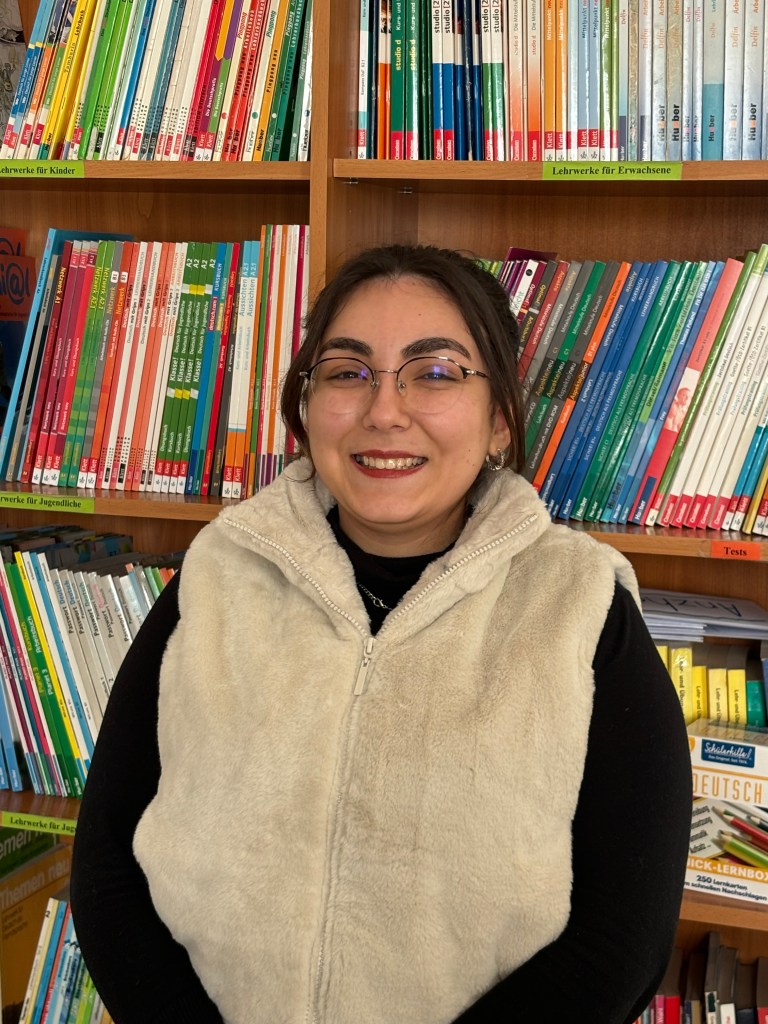
Note: This post was authored by one of my students, Aylin Aydogdu. Aylin is enrolled in two of my writing classes here at Daugavpils University in Latvia. She is from Kayseri, Turkey, and her English, she is proud to say, is self-taught. Aylin, 21, is an international student participating in Europe’s Erasmus Program, and is a full-time student at Erzincan Binali Yildirim University in Turkey.
Aylin Aydogdu
The ground beneath my feet had always been steady, like the promises of my parents to keep me safe. But that day, it betrayed us. The earth, which I thought was my friend, roared and shook so fiercely that I couldn’t stand. My sister screamed, and I tried to hold her hand, but we were yanked apart as everything fell apart around us. The last thing I remember was her small fingers slipping from mine as the ceiling came crushing down.
I woke up under a sky I didn’t recognize, gray with dust and shadows. I was surrounded by rubble, cold and sharp, pressing against my skin. I called for my sister, my mom, my dad…No one answered. Hours passed – or was it days? I don’t know. Time felt broken, like everything else.
When they finally found me, I was too tired to cry. The rescuers pulled me out, their hands rough, but warm. They told me I was lucky. I didn’t feel lucky. As they carried me away, I saw a man sitting in the rubble, holding a small, lifeless hand sticking out from beneath the concrete. His tears had frozen on his face from the cold, and he didn’t move. They told me later he had waited there for 3-days, refusing to let go of his daughter’s hand. I didn’t know her name, but I felt like I had lost her too.
They took me to a shelter where the air smelled like wet clothes and sadness. Everyone had the same hollow look, their faces pale and drawn. A woman sat rocking back and forth, clutching a shoe that belonged to her son. A boy about my age stared blankly at the floor, his arm in a sling. He didn’t speak, not even when I tried to talk to him. Maybe he had run out of words.
I don’t know if I’ll ever have words to describe what I felt. Unadulterated anger, sadness, fear – they all tangled up inside me, fighting to take over. I’d close my eyes and see my sister’s hand reaching for me. I’d hear my mom calling my name, my dad’s voice telling us to run. And, I’d be up shaking, the sound of collapsing buildings still echoing in my ears.
They tell me I have to move on, that life goes on. But how can life go on when everything that made it worth living is gone? I lost my family, my home, my school, my friends. Even the toys I used to play with, the ones that made me feel safe, are buried under the rubble. And every time I think about it, I feel like I’m buried there too.





 Short Talks Through a Wide World